

How many of you heard of the Golden Rule? A quick online search will provide a myriad of results which will tell you that the guideline “treat others how you want to be treated” has existed in some form throughout history across many belief systems and civilizations. Chances are many of you have heard of this “rule” at some point in your life.
But how many of you have heard of the Platinum Rule—Do unto others as they would have you do unto them? The likelihood of you coming across this “rule” is low, even less so if you don’t often delve into the topics of psychology or group dynamics. One reason for this is because the term Platinum Rule was apparently first used back in 1953, which is a relatively short period of time compared to all recorded history. Another reason is the term and concept was published in the Command and General Staff College Military Review which has a very small target audience.
As my unit’s Military Equal Opportunity Advisor, I am always looking for ways to enhance the prescribed annual training. Inspired by a conversation I had with my husband, who first introduced the term to me, I decided to incorporate the Golden Rule and the Platinum Rule into my training. It was during my research into the concept that I discovered the Platinum Rule’s quasi-military origins.
Located between pages 50-55 of the September 1953 issue of Military Review, is the article The Platinum Rule: A Concept of Persuasive Leadership written by LTC Robert P. Haffa while he was a student at the Command and General Staff College. LTC Haffa began his article with a quote from a leadership article written by GEN Omar Bradley,
“The greatest soldier in the world could never win a campaign unless he had the kind of leadership in his make-up which best suited the men he had to lead” … “Perhaps most important is loyalty. On this factor alone battles are won or lost. To be really effective, loyalty must go three ways – up, down, and sideways.”
LTC Haffa states that it is “the loyalty down, the essence of persuasive leadership,” that is harder for most people to achieve. Further he writes “loyalty down requires the capacity to identify with others, to place ourselves in the other man’s shoes, and we have had less practice doing that with subordinates.”
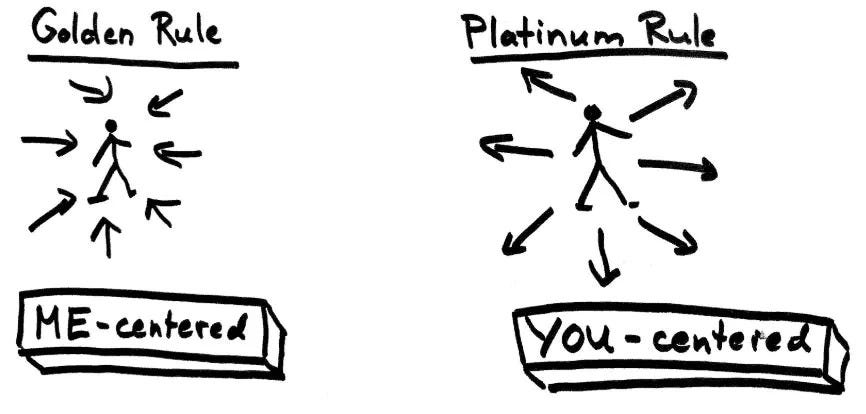
Photo courtesy of LeaderForGood.
On page 51, LTC Haffa posits that the Golden Rule is too self-focused and does not require people to consider others. This is why he called a variation of this rule “Do unto others as they would have you do unto them,” the Platinum Rule. The Platinum Rule requires you to look outside of yourself and think of others prior to or during your interactions with them. So where does this apply to Military Equal Opportunity?
AR 600-20, Chapter 6, Military Equal Opportunity Policy and Program states that the purpose of the program is to formulate, direct, and sustain a comprehensive effort to maximize human potential and ensure fair treatment for all Soldiers based solely on merit, performance, and potential in support of readiness. Further, it states that the philosophy of the program is based on fairness and justice. 6-2 continues by stating that commanders and organizational leaders will foster and maintain positive command climates.
LTC Hoffa suggests that the Platinum Rule and persuasive leadership can be applied to the Army in a positive way that is beneficial to leaders and subordinates. He states that a subordinate’s loyalty is the leader’s reward for exercising persuasive leadership. But how does one get there? The first place to look is at the individual because that is the Army’s most important asset. As he states in his article (and what is taught at the Equal Opportunity Advisor course) each person has their own needs, values, and experiences. These parts of a whole person must be acknowledged before we try to integrate them as a Soldier or Army Civilian.
This approach may seem like commonsense, but how often have we experienced judgement prior to understanding? Further, how can we lead or maximize a follower’s human potential if we don’t know who they are? When we apply the Platinum Rule, we must attempt to acknowledge that what might seem fair, just, or ideal to us, might not seem that way to others.

Good post! From my archives, I'll add a quotation from General George S. Patton from that complements the quotations from General Omar Bradley above: "There is a great deal of talk about loyalty from the bottom to the top. Loyalty from the top down is even more necessary and much less prevalent." (From his book WAR AS I KNEW IT).