

An elegant weapon for a more civilized age
Once upon a time, Army branch journals arrived in stacks to units across the installation. They would land in waiting rooms, staff duty desks, and bathrooms. In a time before smartphones, the journals were always present—something to pass the time.
The transition to all-digital journals has drastically altered how readers engage with them. Articles no longer have to come in consolidated issues, but can be published more quickly. This is generally a boon for writers—they can see their work appear in digital print weeks or even days after submission, while their forebears had to wait for months.
One component of the old branch journals that has yet to be resurrected is letters to the editor. This section was curated reader feedback, printed each issue. Some were attaboys, some were criticisms, and others were notes about how an article resonated or a contribution that the letter-writer wanted to add. Editors sometimes responded directly to the letters on the same page.
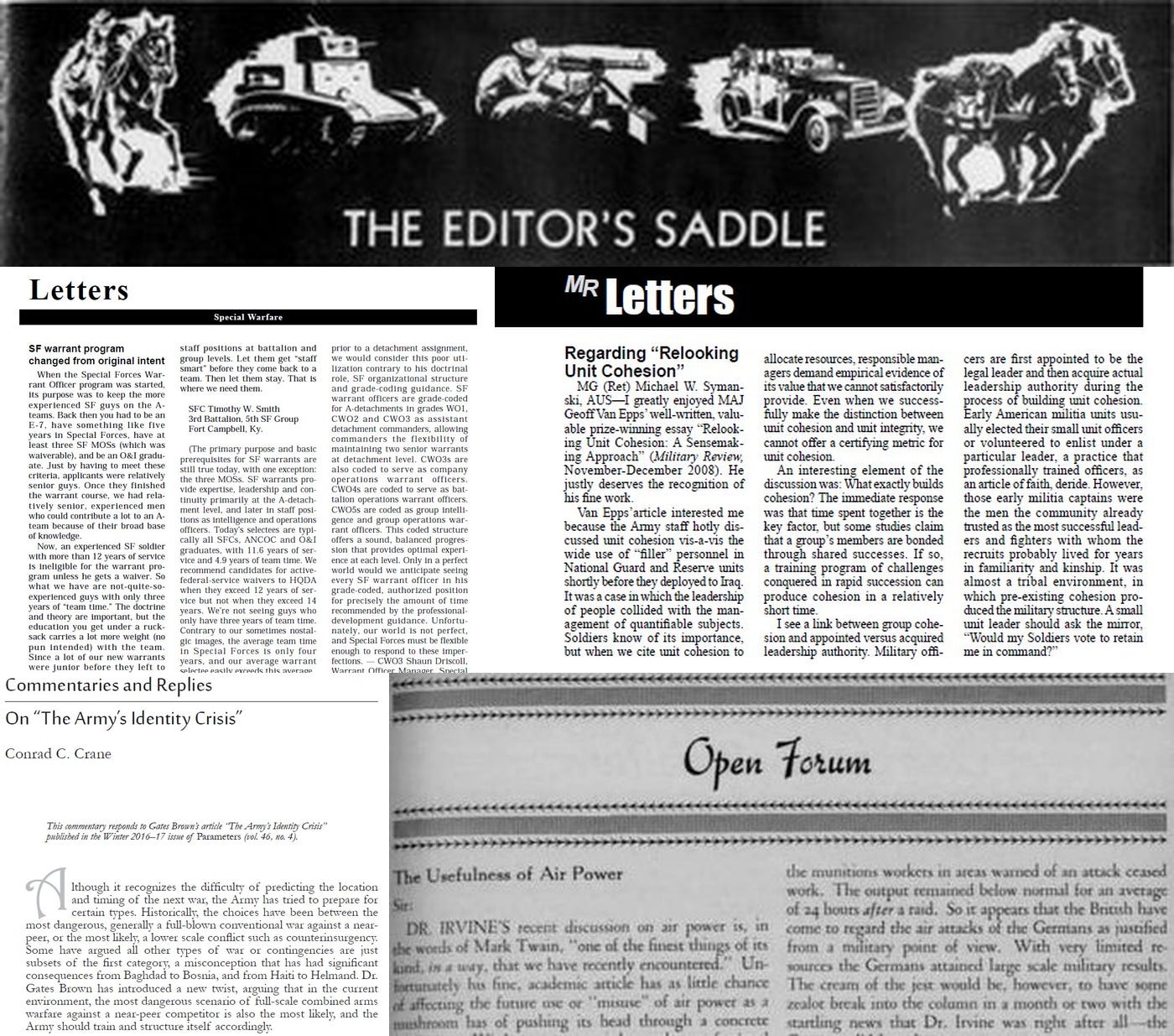
While the letters were meant for readers, they were also a tool for editors. They allowed the editors a form of feedback from the most engaged set of readers. This was an imperfect tool, to be sure, since only readers with the most motivation and time on their hands would write in, but this gauge was better than nothing.
So the question for current and future Harding Fellows across the Army is, how are you soliciting feedback from your readers? Other than letters to the editor, there seem to be three principal alternatives:
Private channels. Editors can and should solicit feedback from readers directly, without intention of printing anything. However, since this correspondence is private, it doesn’t give readers any incentive to join in the dialogue.
Comments sections. These sections allow people to freely comment on articles. Comments are tied to a specific article rather than the journal as a whole—which may or may not be a good thing. Unfortunately, comments sections across social media are frequently toxic and full of bots, and it seems unlikely that it is feasible to host them on an official Army page, though something like a Substack may be an option.
Focus groups. These groups are convened at the editor’s behest, preferably representing some cross-section of readers. They can be convened virtually or in-person and allow the editor to ask probing questions on how content is received and what else the journal might consider adding.
Which brings us back to letters to the editor. Their advantage is that they allow the editor the same level of control that they would exert over private channels, while providing a public signal to the audience that the editor is interested in what readers are saying—and that the editor has the courage to share critical and laudatory remarks, alike. It’s one thing for a reader to know that they are heard through a private channel to the editor, and it’s another thing for a reader to see the editor’s public acknowledgement.
One proposal that might work is to actively solicit letters to the editor over the course of a month or a quarter, and then publish all of those letters—along with a letter from the editor in response.
The comments section is the blaster: fast, indiscriminate, as likely to wound as to find its mark, and increasingly fired by bots rather than people. Letters to the editor are the older weapon—more demanding to wield, requiring discipline from writer and editor alike, but precise, deliberate, and unmistakably human. For Harding Fellows building the next generation of branch journals, it is a tool worth rediscovering. Not out of nostalgia, but because an elegant weapon still has its uses in a less civilized age.

Would love to see someone give this a try! Maybe they could even have the most recent letters posted on the main page on a sidebar or something
Here's am example of an atta-boy postef in LinkedIn that could be a letter to the editor.
I was excited to see proof that senior leaders actually read Army Sustainment which serves as the Logistics Branch journal.
https://www.linkedin.com/posts/dr-theresa-a-smith-023a341a9_army-dasasustainment-readiness-activity-7465879598455664640-PvTv?utm_source=social_share_send&utm_medium=android_app&rcm=ACoAAC0dE8wBwa474yLyGOyusUT6k3HTGCofbvo&utm_campaign=copy_link