

What can the Army Medical Corps of 1901 teach us about surviving and thriving amidst today’s transformation in contact and combat operations?
In 1901, the Army Medical Corps wasn’t just reorganizing, it was reinventing. As William H. Crosby recounts in The Golden Age of the Army Medical Corps the Corps emerged from a period of bureaucratic obscurity into one of institutional clarity and operational relevance. Surgeon General George M. Sternberg, a bacteriologist by training and a reformer by instinct, led the charge. He didn’t just advocate for better field sanitation; he embedded medical logic into the Army’s operational DNA.
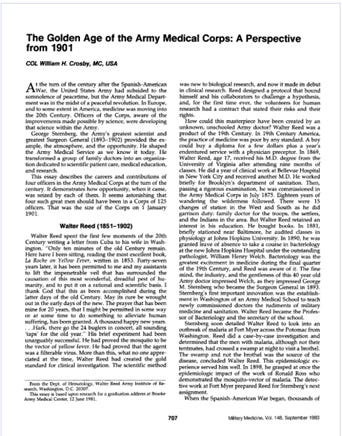
Photo courtesy of the author.
Today, we’re facing a similar moment. The transformation of contact and combat operations, marked by distributed formations, contested logistics, and multidomain complexity, demands a medical capability that’s not just reactive, but anticipatory. The puzzle is clear: how do we ensure the Army Medical Corps remains a strategic asset in this new fight?
Anecdote from 1901: Sternberg’s Doctrine of Prevention
Crosby, a career Army physician and historian who passed away in 2005, captured the Corps’ turning point with urgency and clarity. For him, writing was more than record-keeping, it was a way to leave a lasting imprint on the institution, a voice that endures beyond one’s time in service.
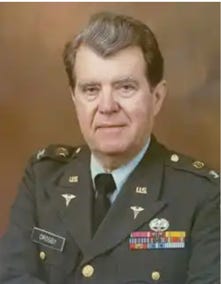
Photo courtesy of the author.
In his account, Crosby highlights a pivotal moment when Surgeon General George M. Sternberg insisted that medical officers be trained not only to treat but also to prevent. Sternberg famously argued that “the best surgeon is the one who prevents the need for surgery.” This was not simply medical philosophy—it was operational doctrine.
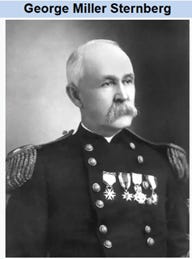
Photo courtesy of the author.
That doctrine reshaped the Corps. Sternberg’s reforms led to mobile field laboratories and routine hygiene inspections, innovations that drastically reduced disease-related casualties during the Philippine campaign.
More than a century later, the principle still holds. Fast forward to 2025: our doctrine now incorporates predictive health analytics, wearable biosensors, and AI-driven triage. Yet the lesson remains unchanged—true medical readiness begins long before the first shot is fired.
Modern Parallel: Transformation in Combat Medical Doctrine
The recent update to FM 4-02 emphasizes distributed care, prolonged field care, and autonomous evacuation platforms. These aren’t just technical upgrades; they’re doctrinal shifts that mirror Sternberg’s vision. The Corps now operates in environments with delayed CASEVAC, degraded communications, and point-of-care medical decision-making.
Just as Sternberg redefined the Corps for expeditionary warfare, we must now redefine it for multidomain operations.
Lessons Learned: Creating Actionable Evolution
Throughout its history, Army Medicine has continuously evolved to meet the challenges of the battlefield, developing technologies and techniques to sustain the fighting force. Capturing and documenting lessons learned has consistently led to innovation. Observations from the Russo-Ukrainian War, for example, provide crucial lessons for U.S. Army Medicine preparing for LSCO. MEDCoE Lessons Learned compiled a list of observations that led to recommendations for Army Medicine, including the need for resiliency training, as well as a rotational deployment strategy. They also highlighted the lack of portable imaging capabilities at Role 1 and the implications that poses for evacuation. The documentation and analysis of lessons learned underscores the importance of interoperability and collaboration with allied forces. They are not merely observations; they are imperative calls to action.
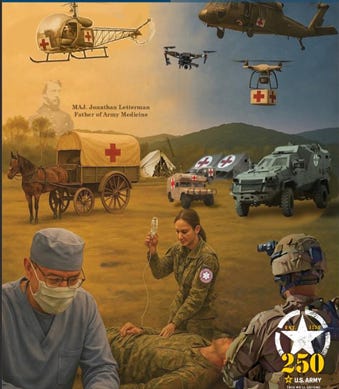
Photo courtesy of the author.
A forthcoming article provides a new list of observations compiled by MEDCoE Lessons Learned on the Israel-Hamas War that will lead to improvements in operational medicine on the battlefield and expanded understanding at all echelons. The Israeli Defense Forces’ experiences provide a blueprint for modernizing military medicine and operational strategies. By emphasizing the importance of adaptability, innovation, and comprehensive care, they meet the challenges of complex and dynamic battlefields and safeguard the health and effectiveness of the fighting force to achieve mission success.
Journal as Mirror and Megaphone: Are We Telling the Right Stories?
We learn from the past, we learn from other conflicts, and we analyze to provide actionable recommendations, yet the Lessons Learned personnel of our commands are not the only purveyors of knowledge. History is full of remarkable accidental medical discoveries from St. Martin’s gunshot wound to the stomach that led Dr. Beaumont learning about the digestive system, to doctors treating heroin addiction in Vietnam discovering that heroin use can lead to pulmonary edema. Medical breakthroughs occur in both ordinary and extraordinary circumstances, yet they will never be innovative unless they are shared. Today’s climate calls for immediacy in shared collaboration. Military Medicine published Crosby’s article in 1983. Forty years later, we must ask: are we still publishing with the same urgency and clarity?
Here’s what the current data says:
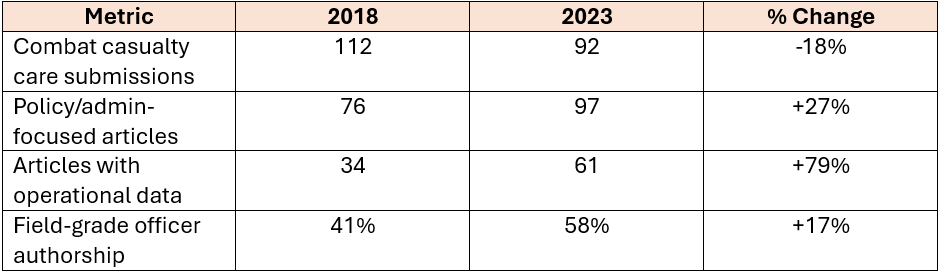
Sources: Harding Project internal analysis, journal submission archives
These numbers tell a story: the Army wants ground truth, not just guidance. Pieces that cite operational data, such as casualty rates, evacuation timelines, or medical logistics throughput, are shared three times more often than those without such data. If we want the rest of the Army to care about our journal, we must write like Crosby did: with urgency, clarity, and historical depth.
A Call to Arms (and Pens)
The Army Medical Corps is once again at a turning point. The transformation in combat operations demands a transformation in how we think, write, and lead. Crosby’s 1901 Corps didn’t wait for permission to evolve; they seized the moment. So must we. What do you have to say? There’s never been a better time to speak up!
