

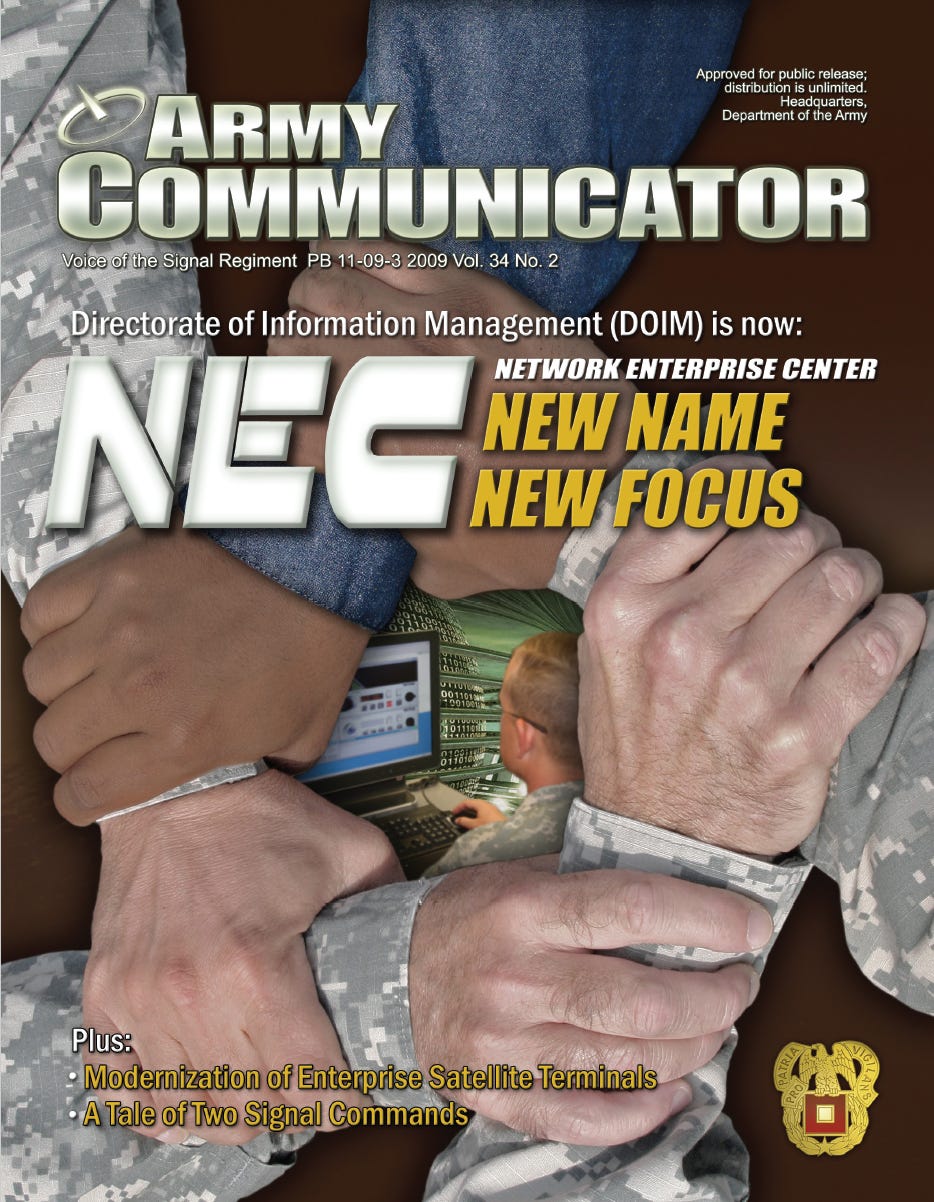
Recently while reviewing previous Army Communicator articles, I came across one that resonated with me and is still very relevant today. Additionally, the author and I have a few similarities.
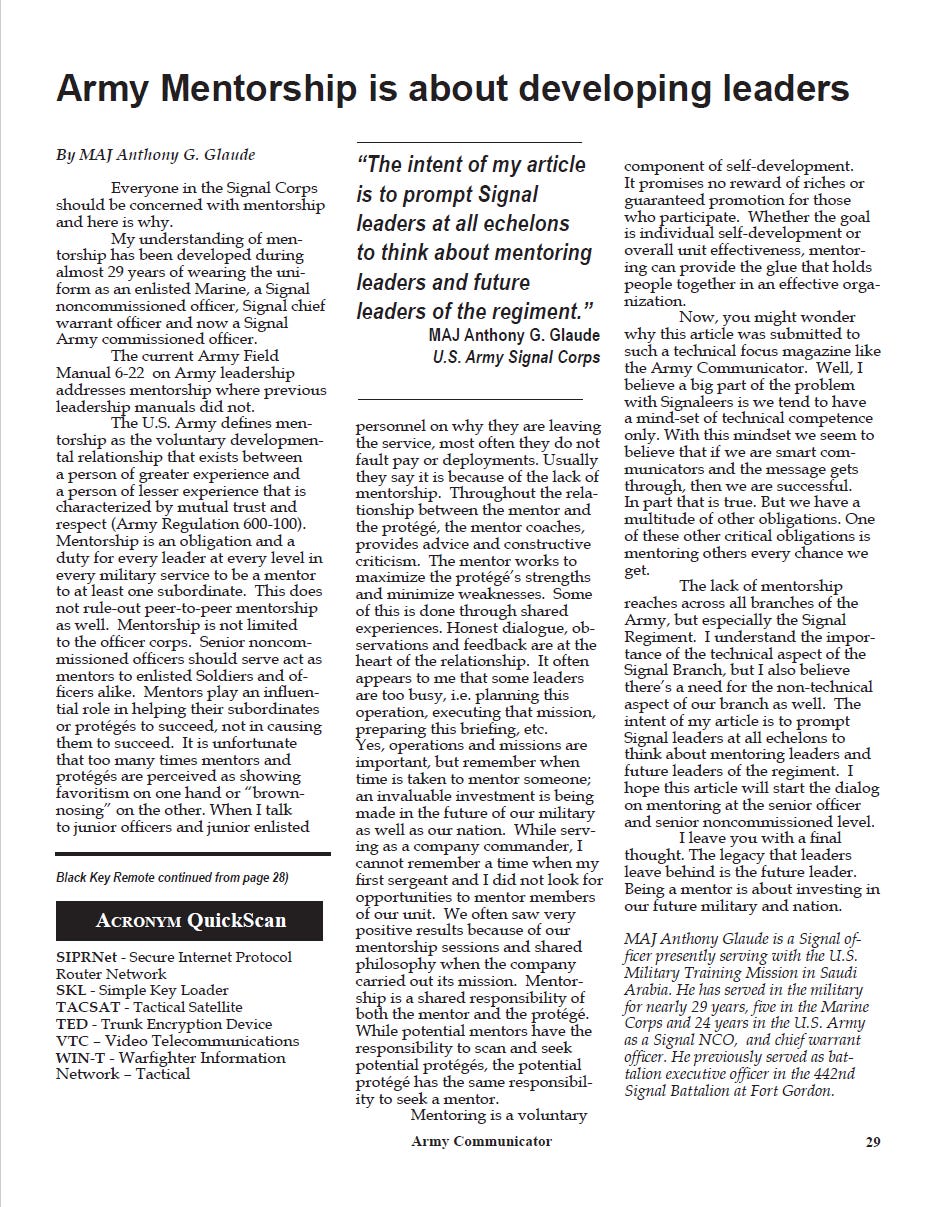
The Article (full version at the bottom)
Published in a 2009 edition of Army Communicator, the article “Army Mentorship is about developing leaders” emphasizes the critical role of mentorship within the Army – particularly the Signal Corps. The author, Maj. Anthony G. Glaude, had 29 years of diverse military experience at the time (I currently have 28 years). Glaude defines mentorship as a voluntary, developmental relationship characterized by mutual trust and respect between a more experienced mentor and a less experienced protégé. Highlighting that mentorship is both a duty and an obligation for leaders at all levels—not just officers but senior noncommissioned officers as well. He stresses that mentorship is essential in developing leaders and retaining talent.
Glaude addresses common misconceptions, such as perceptions of favoritism or “brownnosing,” and refutes them by focusing on mentorship’s true purpose: to coach, advise, and provide constructive feedback that maximizes strengths and minimizes weaknesses. Glaude notes that many junior Soldiers leave the military citing a lack of mentorship as a key factor, rather than subpar pay or deployment hardships.
The article also challenges the widely held technical mindset prevalent in signal units, urging leaders to balance technical competence with the equally vital responsibility of mentoring future leaders. Through shared experiences, honest dialogue, and committed involvement, mentorship serves as the glue that holds effective organizations and units together. In today’s rapidly evolving military environment, where technology and warfare modalities continuously transform, the human dimension – leadership development through mentorship – remains a timeless constant. Modern leaders like me continue to face complex challenges and diverse missions with increased operational tempo that demand more than technical proficiency; they require adaptive, resilient, and well-rounded leaders who are prepared to lead in ambiguity. Glaude’s insights resonate strongly with me and current Army leadership doctrine (such as FM 6-22) which underscores mentorship as a cornerstone of leader development. As the Army integrates more joint, multinational, and technologically sophisticated operations, mentorship bridges the experience gap and fosters a culture of continuous learning and professional growth.
The call to expand mentorship beyond traditional “officer only” circles – to include officer to noncommissioned officers and peer-to-peer relationships – is increasingly relevant today. As a mentor provides guidance to a protégé over time, they develop a professional relationship. By developing this professional relationship, it removes things such as favoritism or “brownnosing,” as mentioned above, and replaces them with bonds of trust to further increase dialogue. In return, the mentor has an obligation to provide time and honest advice to the protégé, regardless of whether they take the insight provided.
Some Perspective
In one of my previous roles, I was a training academic counselor for new lieutenants. While at the range, I was explaining to a lieutenant how to properly zero a weapon and to take their time when shooting the three rounds to get a tight zero. After explaining in detail how to get the right sight picture, take a breath, squeeze the trigger and repeat, the applicant simply took one breath and fired off all three rounds. I was so upset that the lieutenant did not take the advice. All I wanted was for them to pass, and it seemed as if they were working to fail. In the end, I can’t change the mentee; I can only provide advice for them to change.
As I reviewed Glaude’s article, I kept reflecting on how mentors provide honest sound advice and sometimes this may not be what the protégé wants to hear. In my current role as the 26B (Data Systems Engineer) Career Program manager, one of my duties is to work along with the Directorate of Military Personnel Management, Headquarters, Department of the Army; and U.S. Army Recruiting Command on direct commission. I receive emails daily from applicants who want to become officers through this program. However, some only hear the term “direct commission” and automatically assume they are qualified. My job is to provide honest feedback, and sometimes this may not be what a protégé or applicant wants to hear – especially when informed they are not qualified.
Mentors / leaders must ensure they provide honest advice and not tailor their words for what the protégé wants to hear but what they need to hear. When a mentor tells a protégé what they want to hear, the relationship between mentor / protégé changes to friend / friend. To keep that mentor to protégé balance, leaders must remain professional and provide honest feedback for the situation.
I challenge Army senior leaders to provide feedback on the three commissioning sources, being that direct commission has been opened to all branches. My thought was that United States Military Academy and Reserve Officers’ Training Corps was for individuals who want to come in as an officer and are simultaneously in college to earn their degree. Officer Candidate School was for individuals who are currently serving, just received their degree, and lack the experience to be put into an infantry brigade combat team (IBCT) position such as battalion S6 and have phenomenal performance.
Lastly, I thought direct commission was for applicants who have a wealth of experience, can be considered that “unicorn” who can be thrust into an IBCT, and still have phenomenal performance. Lately, it seems as if some individuals are commissioned as part of a numbers game with no real objective between the three commission sources.
Call to Action
I challenge senior leaders to provide guidance on the distinct mission of each commissioning source and seek out protégé – as well as protégé to seek out senior leaders – to ensure we keep mentorship alive and continue to give back to the Army. Today’s operational tempo is not slowing down, so to ensure the next generation of leaders is well prepared to keep “rolling along” (as the Army song says), leaders of all ranks must continue to mentor the younger generation.
Lt. Col. Kenneth B. Redd II, an Oberlin, Ohio, native, enlisted in June 1998 as a combat engineer. In April 2009, he was selected as a Signal Corps officer and attended Officer Candidate School at Fort Benning, Georgia. Redd has multiple deployments including Kosovo, Afghanistan, Iraq.
