

By: Captain Michael McCallister
Author’s Note: The professional journals of the U.S. Army are not just magazines; they are a written record of our tribe’s continuous conversation with itself about the character and nature of war. In these archives, we find our predecessors wrestling with the same fundamental problems we face today. As we digitize these archives, we are unearthing an incredible intellectual inheritance. Sometimes, what we find is not just historical curiosity, but a direct and startlingly relevant message from the past.
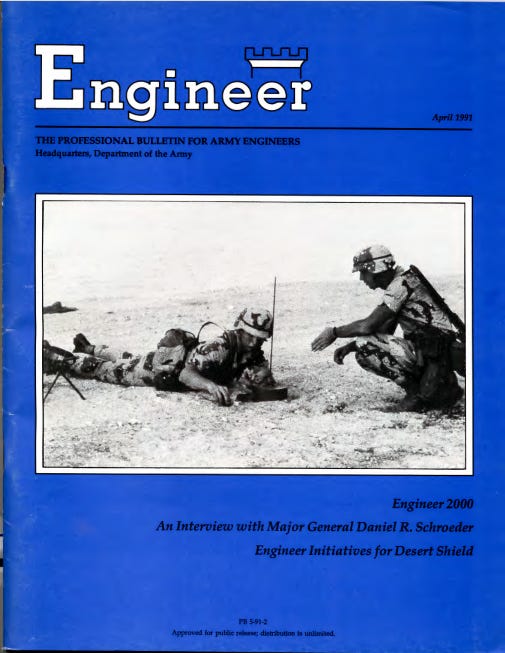
A review of the digitized archives of Engineer magazine from the early 1990s reveals a startlingly prescient article. The year was 1991. The U.S. Army was triumphant after a decisive victory in Desert Storm, yet it was also a time of profound uncertainty. Its primary adversary for over forty years, the Soviet Union, was in a state of terminal decline with its final dissolution just months away. The Army was an institution built to fight a giant that was now ceasing to exist, forcing it to look past long-held assumptions and justify its structure against an unwritten future. It was in this environment that a generation of officers began to look past the horizon. Among them was Major Joseph M. Seerley.
His article, “Force Structure and AirLand Battle-Future“ is a powerful example of this forward-thinking analysis. In it, he argued that the Army could not rest on its laurels and that the existing force design was already insufficient for the future of conflict. While the entire piece is a well-reasoned examination of doctrine and organization, it is a small, unassuming section that stands out for its remarkable foresight.
Below is a direct capture of that section, titled “U.S. Trends” Reading it today is like finding a blueprint for our modern military landscape.
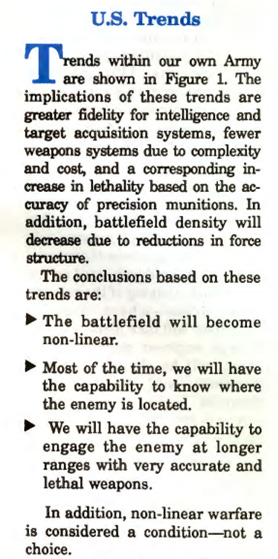
Foresight from 1991: A Blueprint for Modern Warfare
Major Seerley’s conclusions were not just vague premonitions; they were specific, analytical predictions that describe the reality of large-scale combat today.
“The battlefield will become non-linear.”
This concept is now the bedrock of modern military thought, but in 1991 it was a radical departure from the established model of a clear frontline. Major Seerley went further, defining the immense scale of this future battlespace: “This area of operation, much larger than those in current doctrine, may be up to 300 kilometers (km) wide. It will have a depth of 100 km from the back edge of the detection zone to the front edge of the tactical support area.“
With these two sentences, he erased the entire concept of a safe “rear area.” He was describing a battlefield where command posts, supply depots, and field hospitals would be as much in the fight as the frontline troops, a precise vision of the immense challenges of keeping a modern army supplied and functioning under constant threat.
“Most of the time, we will have the capability to know where the enemy is located.”
This prediction foretold the dawn of the “transparent battlefield.” Major Seerley projected the surveillance capabilities of his time forward to its logical conclusion: a state of near-persistent watchfulness from satellites, drones, and other sensors. This insight implied a fundamental shift in tactics. If the primary challenge is no longer finding the enemy, then the new keys to survival become hiding in plain sight, using deception, and, most critically, acting with greater speed than your opponent.
“We will have the capability to engage the enemy at longer ranges with very accurate and lethal weapons.”
Paired with universal detection, this capability creates the modern kill chain. He understood that when you can see everything, and you can strike anything you see, the old rules of warfare change. He was foretelling the lethal, long-range duels that now define peer conflict, where the ability to strike deep into an enemy’s territory to disrupt their systems is a prerequisite for success.
“In addition, non-linear warfare is considered a condition—not a choice.”
This is perhaps his most profound insight. He recognized that these technological trends were not creating a new menu of tactical options for a commander to choose from. Instead, they were forcing an inescapable condition upon all armies. The proliferation of sensors and long-range, precision weapons would make traditional warfare obsolete. The only choice left was to adapt or to be destroyed by it.
Why Write?
The discovery of this article begs a critical question: why does this 35-year-old text still hold such power? The answer is simple. Major Seerley wrote it down. He took the time to articulate his analysis, refine his argument, and submit it to the professional discourse of his day. He treated the branch journal not just as a source of information, but as a forum for debate.
This creates a professional obligation. The challenges of our current era are no less significant than those Major Seerley faced. By contributing to the professional conversation, one does not simply publish an article. One plants a seed for the future, creating a data point for the leaders of 2050 who will look back, just as we are doing now, to understand how the Army of our time grappled with its own moment of transformation.
Remarkably, this article was not an anomaly. A survey of the professional journals from that era, including Engineer, Army Chemical Review, and Military Police, reveals that a whole generation of officers was thinking deeply about these problems. They were laying the intellectual groundwork for the Army we are now trying to build.
This discovery serves as a powerful reminder that our most pressing “modern” challenges are not new. We are standing on the shoulders of the thinkers who came before us. Their wisdom is still here for us to access, and our professional archives are not a graveyard of old ideas, but a living library of hard-won knowledge. The only way to tap into this wealth of experience is to read the journals and discover it.
*AI assisted with editing for style and clarity. All ideas and analysis are original to the author.
CPT Michael McCallister is the inaugural Harding Fellow for Protection at the Maneuver Support Center of Excellence. He is Editor in Chief for the Protection, Army Chemical Review, Engineer, and Military Police professional bulletins. He holds a bachelor’s degree in English from Illinois State University in Normal, Illinois.
