

Chaplain (Major) John Hoogland was assigned to the U.S. Army Chaplains Board in 1971 and arrived thinking he was in trouble. The Board had a reputation for being a place where the Chief could hide chaplains away from the operating force. Instead, Hoogland was assigned the task of creating a journal from the ground up. The U.S. Army Chaplain Corps published Military Chaplains’ Review (MCR) quarterly from 1972-1992 in no small part thanks to Hoogland’s initial vision and efforts. MCR did not survive the steep cuts that came with the end of the Cold War. What came in its wake were less ambitious and under-resourced publications that fell short of the original vision of MCR as a forum for important conversations and debates about the nature, practice, and history of military chaplaincy.
Chaplains deserve an academically rigorous, professional forum to have those conversations. Such a forum needs the consistency of regular and relevant publication. It also needs as much independence as possible to preserve the integrity of that conversation; it deserves caretakers who are interested in the variety of expressions of military chaplaincy and the needs, challenges, and fissures entailed. For all its faults, and there were many, Military Chaplains’ Review provided something close to that for Army and other military chaplains from 1972-1992.
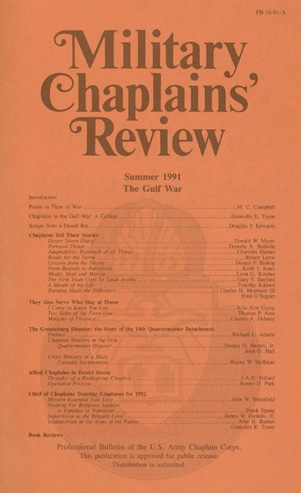
Photo courtesy of the author.
Military Chaplains’ Review
Hoogland modeled Military Chaplains’ Review after Military Review. He insisted that it be a true professional journal and not serve as a “public relations vehicle.” In an interview for the twentieth anniversary of MCR, John Hoogland said: “My argument was, instead of calling it the Army Chaplains’ Review was to do something new. We can include the Navy and the Air Force. I argued to make it the Military Chaplains’ Review. . . . Is it so different being a Navy Chaplain?” With the resources of the Board at his disposal, Hoogland was able to host conferences and contract with civilian academics from various disciplines to present papers that would later be published in MCR. The first conference and then issue of MCR featured the now cringeworthy title: “Ministry to Blacks.” Even so, it featured the work of important Black civilian scholars and chaplains and tackled relevant issues of the day.
In addition to papers by prominent civilian scholars, Hoogland begged for submissions from the field. He received a lot of “term papers” that required significant editing. The quality of those articles is uneven and in hindsight the issues and topics are equal parts surprising, disconcerting, and flat-out cheesy. But we are talking about chaplains and ministry and those in ministry will recognize those as evergreen adjectives. Through the years, MCR tackled many important and timely issues like Women’s Issues (bad title, but a genuine effort), the AIDS epidemic (in 1988!), as well as Medical Ethics, Operation Just Cause, and the Gulf War. The issue on the Gulf War was one of the last published (Summer 1991) and received an Award of Merit for coverage of Operation Desert Storm from Associated Church Press. There are numerous articles on the practice, nature, and history of military chaplaincy that have value to this day.
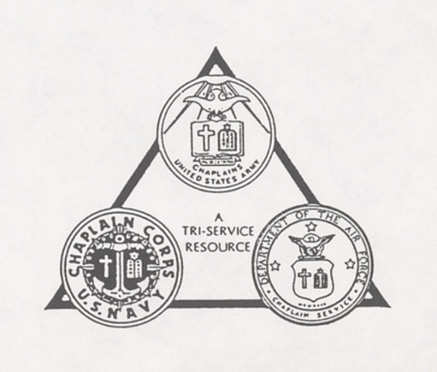
Photo courtesy of the author.
MCR was the professional bulletin of the U.S. Army Chaplain Corps but included contributions from Navy and Air Force chaplains, civilian academics, and even spouses. It was a “Tri-Service Resource” for Army, Navy, and Air Force Chaplain Corps that was mailed to every active duty Army chaplain, active duty Navy chaplain (starting in 1980), and active duty Air Force chaplain (starting in 1982), as well as many reservists. All told, MCR was mailing over 6300 copies to chaplains in the U.S., Canada, and Australia, as well as numerous theological libraries, endorsing agencies, and others.
The Department of Defense and the U.S. Army faced steep budget cuts and significant drawdowns after the Cold War. 1992 was a year of significant tumult and transformation across the force and in the Chaplain Corps in particular. The Office of the Chief of Chaplains (OCCH) ran a significant number of programs and projects through the US Army Chaplaincy Services Support Agency, an Army Field Operating Agency (FOA) directed by the Deputy Chief of Chaplains. The FOA did not survive the cuts in 1992 and neither did Military Chaplains’ Review which was published by the FOA. The Summer 1992 issue of MCR was the last one published with the downsizing of the Army and the Army Chaplain Corps (Tyson, v). The responsibility for the branch publication fell to the US Army Chaplain Center and School where it was given new leadership, focus, format, and a new name.
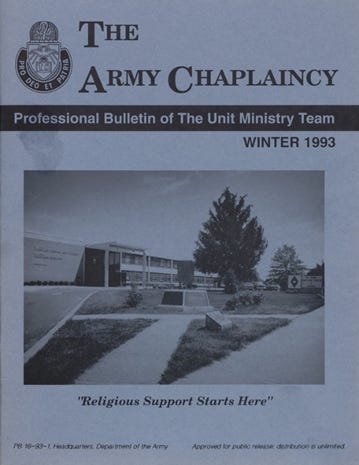
Photo courtesy of the author.
The Army Chaplaincy
A string of educated and ambitious Regular Army Chaplain (Majors) led MCR as editors with the support and resources of the FOA. The Chaplain School’s Public Affairs Officer took on the role of managing editor for The Army Chaplaincy: Professional Bulletin of the Unit Ministry Team as an additional duty. The first issue of The Army Chaplaincy was published in Winter 1992. MCR was inaugurated with an issue focused on how (predominantly White) chaplains might better understand and care for needs Black Soldiers. The first Black Chief of Chaplains heralded the new publication on its first page. The Commandant of the Chaplain School, Chaplain (Colonel) Bernard H. Lieving, Jr. did not mince words: “With the downsizing of the force . . . it was necessary to move the responsibility for the Review to the Chaplain Center and School. This change required a narrowing of the focus.”
The Army chaplaincy’s professional publication went from a commons for English-speaking chaplains with an (at least aspirational) Joint focus on conversations with civilian academia to a publication with a mostly narrow focus on Army training and doctrinal concepts. It also moved from a quarterly publication to an incredibly inconsistent publication (with one to two issues a year, or none at all); it also had an embarrassing overreliance on clip art. Without strategic levels of support and vision, The Army Chaplaincy floundered for its two decades of life with extremely inconsistent quality, publication, and distribution.
Before it shuttered, MCR surveyed its readership across four areas: Who are the readers? What are their attitudes toward MCR? Do they have any desired changes to be more effective? How effective is distribution system? Chaplain (Major) Rick Whitesel shared the “Results from the Readership Survey of the Military Chaplain’s Review” in the second issue The Army Chaplaincy. Overall, readers “Feared change of any kind would result in the loss of substantial content.” Readers wanted “serious content” and some worried that MCR “served only as a mouthpiece to praise the chaplaincy.” (The Army Chaplaincy (Spring 1993), 28-29). 86% of readers found MCR to be helpful reference work. 35% used it as a reference in the 12 months prior to completing the survey. Whitesel’s most damning conclusion from the survey results was that “the decision to terminate the Military Chaplains’ Review was a mistake. The survey indicates that there is a market for a professional journal for military and federal chaplains (VA and prison) that is not being met. It may be that the need is not being met anywhere in the English-speaking world (USA, Canada, Great Britain, Australia, and so on.) The MCR was one of, if not, the, oldest and longest running interservice professional journals in the world. To have simply canceled it in an era of rising interest in joint activities of all kinds, represents a lack of vision for the potential of a professional journal” (33).
That second issue of The Army Chaplaincy would be the last issue published for two years. After that, publication remained spotty and inconsistent with years long gaps until it was unceremoniously ended in 2010. It was briefly revived as The Chaplain Corps Journal in 2014 and 2015, with one issue published each year. It took three more years before it was rebooted as The U.S. Army Chaplain Corps Journal in 2018 as an annual publication. OCCH funded the first full-time, civilian editor for the position in 2020 as a term hire to ensure the capacity for quality and consistent publication.
Conclusion
The U.S. Army Chaplain Corps and U.S. military chaplains more broadly are still working to recover from the loss of Military Chaplains’ Review. The challenges in 1992 were budgetary. The loss of MCR meant that less than a decade later, when the U.S. invaded Afghanistan, there was not a publication poised to host a rigorous and reflective conversation with Joint and civilian academic partners about the things that mattered most for the work of military chaplains. There were other challenges facing chaplains to be sure, but those challenges were exacerbated by the fact that they did not have a credible commons for professional conversation at the moments they needed them during two decades of war in Iraq and Afghanistan.
Today we face both budgetary and philosophical challenges to the kinds of conversations Military Chaplains’ Review was able to host in the 1970s and 1980s. In this period of retrenchment, The Harding Project is currently working to institutionalize gains in professional publication expertise and capacity across the Army enterprise. The Chaplain Corps needs to do this as well.
Military Chaplaincy Review began publication under that name in November 2024. The name change represents more than just a nod to Military Chaplains’ Review. It represents an effort to return to that tradition with a key difference—a recognition that chaplains are an important part, but not the only part, of the work of military chaplaincy. Military Chaplaincy Review is getting its feet under it, but it is still young and toddling about. All that while the rug could still be pulled out from under it at any moment. MCR needs the stability of a full-time, civilian editor with a background in military chaplaincy and a PhD in a related field. The position needs to be a permanent part of the TDA at U.S. Army Institute for Religious Leadership. MCR also needs its own equivalent of a Harding Fellow, a Regular Army chaplain with additional civilian education to infuse the publication with energy and new ideas. Given the aspirations at MCR for a global conversation, a future in which the publication is also supported by Joint or even multinational partners would not be a bad thing.

Adam, thanks for writing this. I appreciated learning your journal's history!
As a scholar who (almost literally) stumbled upon my dissertation topic by thumbing through old copies of MCR in the basement of Davis Library, fascinated by the rich conversations of the late Post-Vietnam era chaplaincy, this history of the MCR helps tell a little of my own scholarly journey and the intellectual history of my own work. I'm so happy to see and play a small part in the work that Adam and his team are doing with the Military Chaplaincy Review today. The wandering and lost years of the 1990s and 2000s were a real loss for intellectual development and professional introspection for the Chaplain Corps. Chaplains' dual-professional identities are formed, in part, by professional publications that introduce, shape, define, reinforce, or redraw the boundaries of identity, ethics, standards, practice, vocation, norms, and collective behavior. And when chaplains don't have a place to do that work *together,* the profession suffers.