

Hello Fellow Hardos!
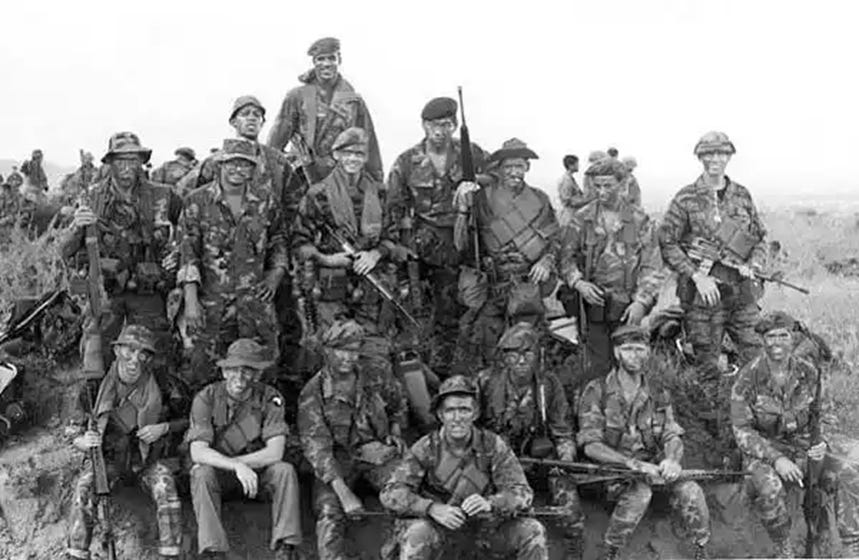
Photo from the 101st Airborne Division (Air Assault) Don F. Pratt Museum at Fort Campbell Facebook Page.
I’ve enjoyed reading the THROWBACK THURSDAY and other HARDING HISTORY posts. Over the past year, I have seen articles on how ground reconnaissance has changed in the new environment of ubiquitous surveillance under the threat of drones, as well as a couple of articles on the revival of “The Green Hell” with the Combined Jungle Operations Training Center (CJOTC) in Panama. These articles reminded me of a situation that I found myself in back in February 1986 when I was selected as the first commander for the Long Range Surveillance Detachment (LRSD) in the 101st Airborne Division (Air Assault).
I’m writing this post to share with my fellow Hardos about an excellent document that we used to help develop our tactics, techniques, and procedures (TTPs) to perform the long range surveillance mission for the 101st ABN DIV (AASLT). As Mark Twain is reputed to have said, “History doesn’t repeat itself, but it often rhymes.”
The initial cadre of NCOs and I found ourselves assigned to a new unit where there was no current doctrine. After the publication of AirLand Battle doctrine in the 1984 version of FM 100-5, the Army determined that division commanders needed a dedicated ground long range reconnaissance and surveillance capability. At the time our unit stood up, the Infantry School was still working on the draft field manual (the first version of FM 7-93 Long Range Surveillance Unit (LRSU) Operations was not published until June of 1987). Other than the Ranger Handbook (then numbered ST 21-75-2), the only existing doctrinal reference was the Vietnam-era FM 31-18 Long-Range Reconnaissance Patrol Company dated August 1968.
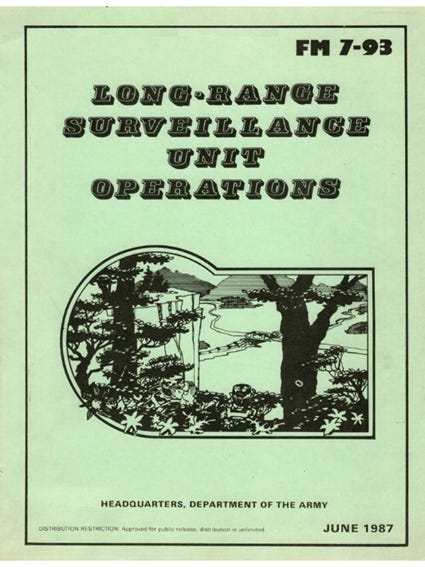
Photo courtesy of author.
However, before we started on any of the myriad of tasks to activate a new unit, my cadre consisting of the XO, 1SG, first six (6) TLs and I received TDY orders to go to Fort Bragg for the Pilot Long Range Surveillance Course taught by the US Army John F. Kennedy Special Warfare Center & School from March-May 1986. This course was a modification of the Special Forces Special Reconnaissance (SR) Course tailored for the new conventional Army LRSUs, and only taught at Fort Bragg this one time. Personnel from the LRSDs at 7th ID(L), 25th ID(L), and V Corps also attended. Selected cadre from the (then) Ranger Department shadowed/assisted the course for their later stand-up of the Long Range Surveillance Leaders Course (LRSLC) at Fort Benning in October 1986.
One of the great documents that we received from the SR Course cadre was the Detachment B-52 (Project Delta) Reconnaissance Tips of the Trade published by 5th Special Forces Group (5th SFG) HQ in Vietnam on 15 August 1970. This is the cover page:
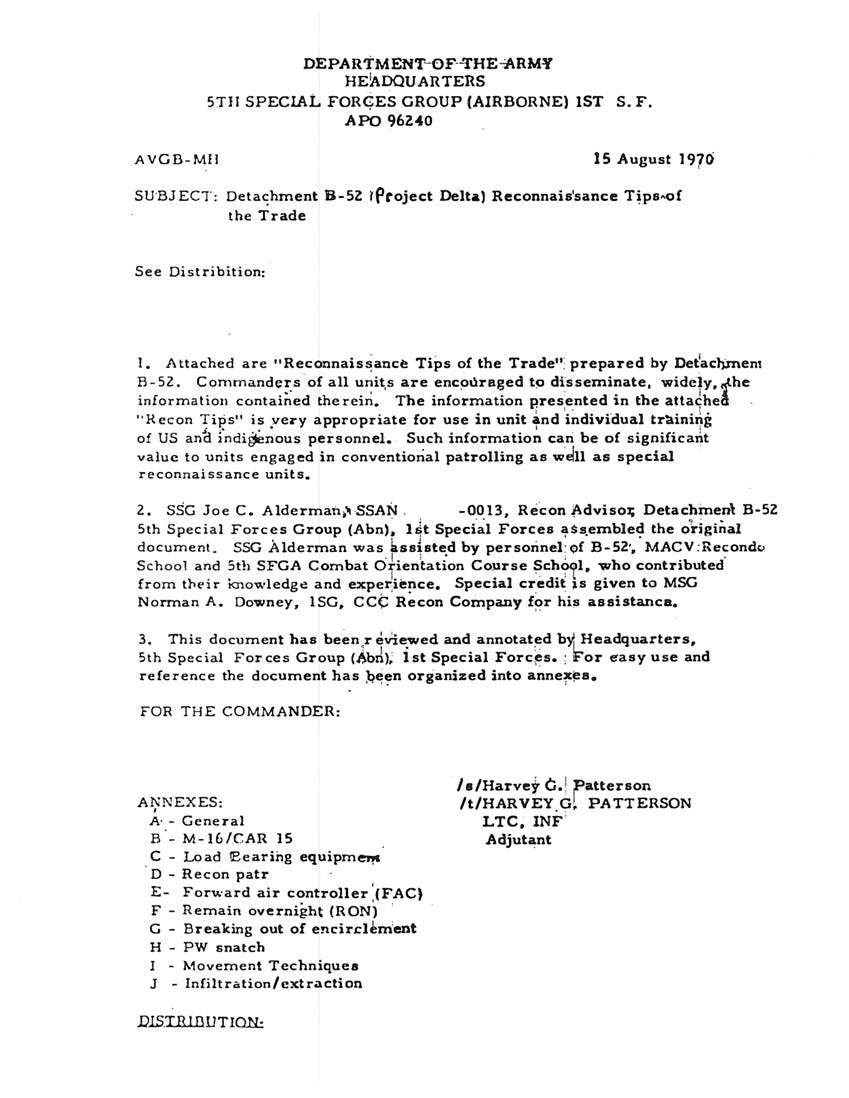

We found this document especially useful because, at that time, the majority of the contingencies we trained for in the 101st ABN DIV (AASLT) were in Central and South America, with many areas having similar terrain and environment as Vietnam. In June 1986, to reinforce the value of this document, the division tasked our unit to assist with hosting the first reunion of the Vietnam veterans of the 101st ABN DIV who served in the 1st BDE LRRPS from 1965-1967, F-58th Infantry (Long Range Patrol) from 1967-1969 and L-75th Infantry (Ranger) from 1969-1972. During our discussions over many beers listening to war stories from these veterans, especially from the L-75th INF timeframe, they validated their use of the DET B-52 Recon Tips of the Trade as well as what they learned at the MACV RECONDO School run by 5th SFG in Nha Trang.
The TTPs in this document cover many areas including general team leadership and organization, weapons, load bearing equipment, Forward Air Controllers, Remain Overnight (RON) and movement techniques. Many of these TTPs have stayed in use with Infantry, Ranger, and Special Forces units, and many of you will be familiar with them. In fact, I would bet that many of the older Hardos reading this post may have a copy of the Detachment B-52 document in their professional libraries.
Some of you may be surprised that this is where many of these TTPs may – I repeat, may – have first been formally written down:
“The last three rounds in each magazine should be tracer. This reminds the firer that he needs a loaded magazine.”
“Always use water from canteens on or in your rucksack before using the canteens on your belt. This will ensure a supply of water should you lose your rucksack.”
“Check all team members pockets prior to departing homebase for passes, ID cards, lighters with insignias, rings with insignias, etc. Personnel should only carry dog tags while on patrol.” (And today – check for cell phones!)
“During the rainy season take extra cough medicine and codeine on patrol.”
The tip that is most meaningful for the future, especially as the Army is going through “Transformation in Contact” and adapting to the new environment of drones on the battlefield, is the last tip on page 29 of the document:
“In closing I might remind you that your tactics and techniques are only as good or effective as you make them. This can only be done through constant practice, training and rehearsals.”
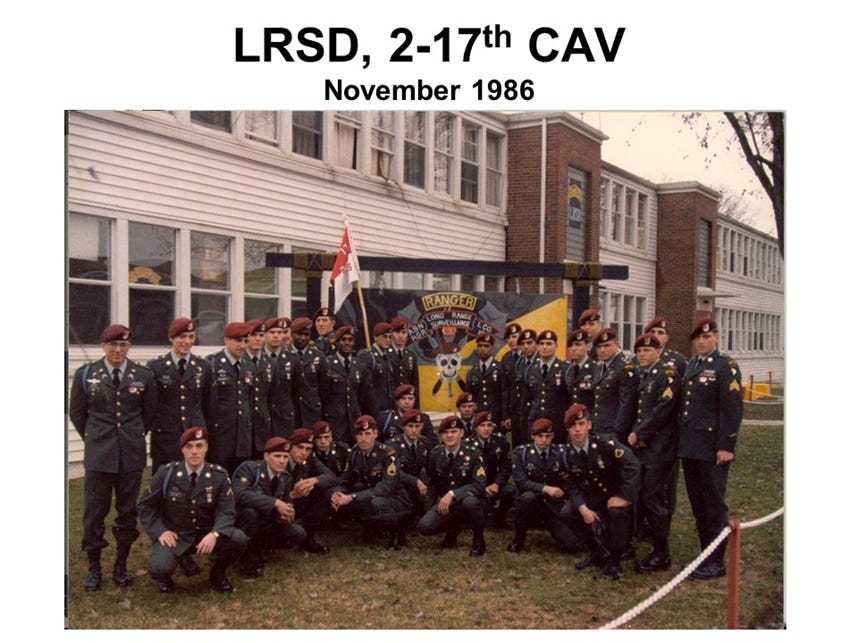
Photo courtesy of author (located far left).
I hope you take the time to read the attached file and perhaps find something that may be useful to you in your unit. Thank you and enjoy your weekend reading!
Barrett F. Lowe
COL, USA (ret)

I don't see an attachment to the file. Am I missing something?