

“Check the Block” Training
What is arguably the biggest complaint of soldiers in the Army? That would be having their time wasted. Stale or cookie cutter training is not often seen as a “waste of time” because at the end of the day it IS training, however, just going through the same motions does not necessarily generate improvements. Training for certification is often a “by the numbers” event and rarely includes any groundbreaking content or lessons learned. As the Army, is entering a period of rapid growth, transformation, and modernization, we must ask ourselves can we afford to waste time with the same old methods of training? The war in Ukraine exemplifies how conflict in the modern era evolves day-by-day—so too should our training. Tactical leaders should use field exercises, gunnery, and CTC rotations to experiment with new tactics, defense designs, and technology.
Battling ‘Demons’ at the NTC (ADA Magazine, Spring 1985)
A standout article on experimentation in training was published in the Spring 1985 edition of the ADA Magazine. Titled: Battling ‘Demons’ at the NTC, this article explores the decisiveness exhibited by LTC E. Paul Semmens, commander of 5-52 ADA, at the National Training Center in Fort Irwin, California. The ‘demon’ referred to in the title is uncertainty, which the article defines as “a lack of knowledge essential to the accomplishment of a mission”. The primary level of uncertainty at NTC, and any military operation, derives from decisions made by the enemy/OPFOR. LTC Semmens decided to attack this by deviating from the “norms” and experimenting with new tactics. The three primary changes were exchanging the Stinger platoon’s jeeps for Armored Personnel Carriers (APCs), using new tactics with his Vulcan platoon, and supporting an attacking task force with a battery (minus) to aid logistics.
The typical vehicle for a two-man Stinger crew (in 1985) was a jeep and trailer. However, being so close to the forward edge the jeep does not provide nearly enough survivability. This usually leads to Stinger crews joining the maneuver unit’s APCs, but limits their carrying capacity for missiles. Semmens decided to swap the Stinger platoon’s jeeps for the Chaparral platoon’s APCs. Since the Chaparral is usually emplaced in rear areas, Semmens accepted the risk of them losing the more survivable APCs. The added mobility of the APC, coupled with its survivability, allowed the Stinger teams to take up positions not typically possible with the jeeps, which gave the commander more options when defending his unit. While it wasn’t without its own challenges (training crews to operate the APC and teaching new tactics) the swap was seen as an overall success, with the PSG stating, “We need and deserve our own APCs.”
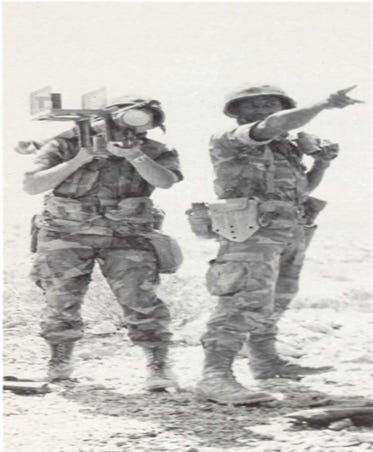
PV2 Jim Gilkins aims his Stinger at an Approaching Aircraft while SGT Robert Nelms Points out the aircraft’s location. Photo courtesy of author.
At this time, Vulcan doctrine called to array them in a box formation, which gave balance and cover on all flanks. With the Stingers combined with the attacking force as well as Vulcans, LTC Semmens chose to experiment with a new tactic: a line formation. Using terrain analysis and enemy air avenues of approach with the S-2, Semmens decided that if there was advantageous terrain for the enemy, it would be beneficial to give up balance for mass to cover that terrain (with Stingers as cover). Though situationally dependent, LTC Semmens noted that the mass was an effective tactic.
A final tactical change LTC Semmens made was using a battery (minus) to support attacking forces. Utilizing the majority of the battery at the front enabled the battery headquarters to effectively establish a well-oiled logistics and personnel action system, rather than relying on the supported unit. This system worked so well, it was later used by a subsequent battery’s training rotation to NTC.
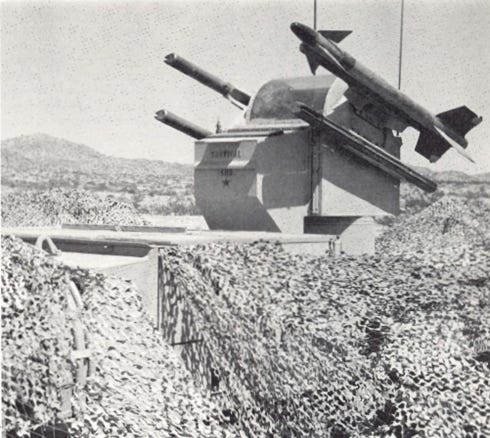
A Chaparral from 5-52 ADA locks onto a target during operations at NTC. Photo courtesy of author.
Why this resonates
While CTC rotations have objectives that need to be met, they should also be opportunities to experiment. Most soldiers like to train hard and learn new things, much like the Stinger teams of 5-52 ADA when they had to learn how to operate the APC instead of their typical jeep. Furthermore, with the development of new systems, like the Integrated Battle Command System (IBCS), training and exercises are the perfect time to test full capabilities and limitations. The central selling point of IBCS is its ability to give commanders flexibility across the battlefield with their assigned weapon systems. Commanders in IBCS-enabled Battalions should learn from LTC Semmens willingness to think “outside the box” when it comes to how they use the “any-sensor, best shooter” flexibility offered by IBCS. Leaders outside Air Defense can also learn from this willingness to use training as a “test” opportunity.
The Air Defense Artillery Journal: Why Write?
The heritage of the Air Defense Artillery Journal (ADAJ) can be traced back over a century ago to the branch’s predecessor: The Coastal Artillery Journal. Although it has gone through several name changes and a couple hiatuses, the ADAJ continues to be the source of professional discourse for the branch. With Air Defense operating at an incredible op-tempo one question seems to pop up often: “Why spend downtime writing?”. The ADAJ offers Air Defenders at all levels the ability to spread their knowledge, ideas, and complications across the force. Senior leaders can communicate major changes coming to the force, commanders can relay lessons learned from CTC rotations or deployments, and junior leaders can bring up issues to be addressed by senior leaders who can create change.
Call to Action
It has been said by many senior leaders that the force needs to transform quickly in order to meet the demands of modern warfare. This includes new technology being rapidly fielded to introduce new capabilities or remove deficiencies. Key to this is experimenting with these new systems and pushing them to their limits. Just as important is sharing the results of these experiments so that others can learn from their success and failures.
Air Defenders and Army Professionals at all levels, this is your call to action. Read: stay informed of what is happening in the force and take the lessons learned. Reflect: every CTC rotation, deployment, field exercise, or gunnery certification is an opportunity to learn and improve. Write: take these lessons learned and put them into articles for publication to keep driving positive changes in the Army.
CPT Peter Neil II is the Air Defense Artillery Harding Fellow. He works for the ADA Commandant’s Office, FCOE, Fort Sill, Oklahoma. He holds a Bachelor’s Degree in Mechanical Engineering from the Citadel: The Military College of South Carolina.
