

Editor’s Note: In 1911, the professional voice of the American Redleg was the Field Artillery Journal. It was a place for Soldiers to debate the future of their branch on paper, a forum that would shape the Army for the coming Great War.
This journal began a tradition of professional discourse that has never broken, even as its name and form have evolved. Over the decades, it has been Combat Forces Journal, the Field Artilleryman, and the joint Fires Journal, before being restored once again as the Field Artillery Professional Bulletin.
Where we started was a journal passed from hand to hand. Where we are now is a fully digitized archive, putting a century of debate and lessons learned just a click away. This incredible access allows us to reach back in time and pull forward ideas that are as relevant today as when they were first printed. Sometimes, we find a voice that isn’t just relevant, but prophetic. You can read more about the history of the publication here.
Imagine a young field artillery lieutenant in a cramped command post today. The air is thick with the hum of electronics. On one screen, a drone feed shows the thermal signature of an enemy vehicle. On another, targeting data streams in from a forward observer and is fused with data from overhead ISR assets. With a few keystrokes, the lieutenant unleashes a volley of precision-guided munitions that will strike a target miles away, a target the gun crews will never see. It feels like the pinnacle of modern warfare.
Now, rewind 110 years.
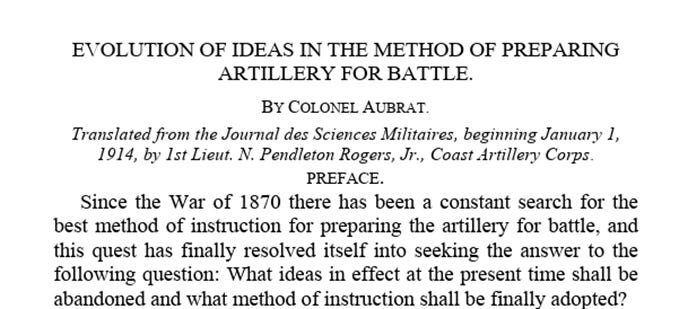
A French artillery colonel named Aubrat, writing in a military journal in January 1914, is grappling with a revolution. His world is being turned upside down by a single piece of technology: the 75mm rapid-fire gun. In his article, “Evolution of Ideas in the Method of Preparing Artillery for Battle,” he isn’t just documenting change; he is, with uncanny prescience, writing the very first chapter of the playbook our modern lieutenant is using. This dusty article isn’t a history lesson; it’s a ghost whispering the fundamental truths of our profession—truths we must never forget.
Light and Lethal Field Artillery… and the End of the Gentleman’s Duel
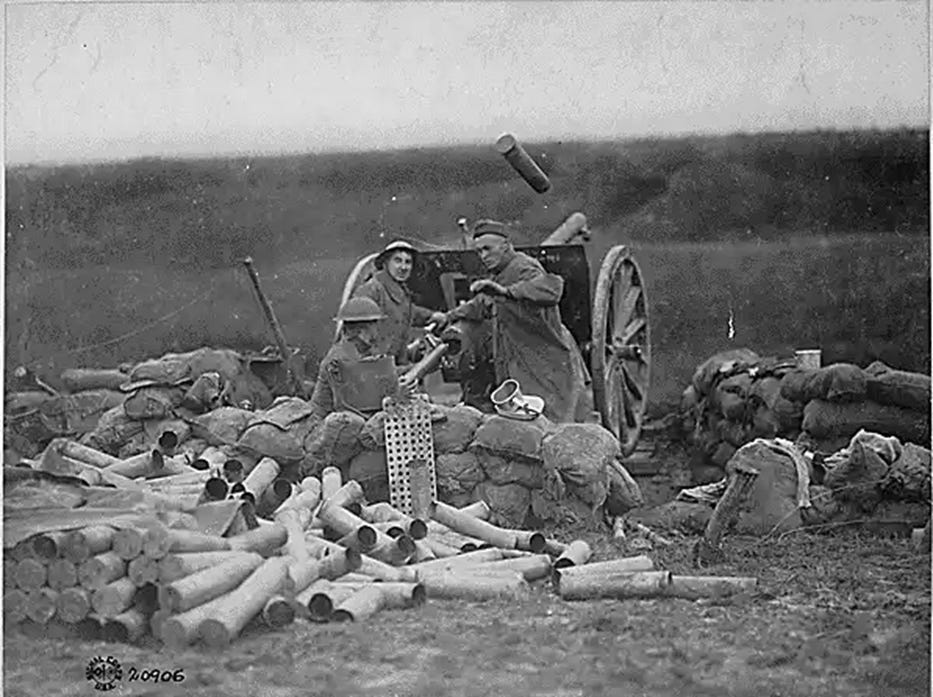
Before 1914, artillery was a spectacle. As Aubrat describes, battles began with an almost ceremonial duel. Opposing artillery batteries would line up on opposing ridges, in plain sight, and blast away at each other. It was a contest of visible strength, a slugfest in a boxing ring “in view of both armies.” The job was simple: destroy the enemy guns, then turn your attention to the infantry.
The introduction of the French Canon de 75 modele 1897 howitzer, with its quick-firing breech and recoil mechanism, eroded this tradition. Soldiers saw that volume of fire that a battery Soixante-Quinze, or 75’s, offered promised to become so immense that sitting in the open on a ridge was no longer a realistic maneuver. It was suicide. This single technological leap forced a question that echoes to this day: How do you kill the enemy before he kills you?
The answer, Aubrat explains, was a radical and controversial idea: disappear.
He chronicles the “stages of evolution” as pioneering officers, against the protests of the old guard “Conservatives,” began moving their guns off the crests and open high ground. They first placed them behind ridges, hills, and tree lines. Then moved them further back from places we know as the FLOT or LOD. This was the birth of indirect fire as a standard practice. Aubrat’s contemporaries were moving from being riflemen with giant guns to becoming masters of geometry and distributed lethality. The modern concept of “shoot-and-scoot,” where self-propelled howitzers fire and immediately move to avoid counter-battery fire, is the direct descendant of this first, desperate scramble for cover. The mission of survivability remains the same in 2026 as it did more than 110 years ago.
Fighting an Invisible Enemy
The second revolution Aubrat identifies is even more profound. Once the guns were hidden, a new problem arose: what are you shooting at? Soon, gunners “in the rear” could no longer see their targets.
He pours scorn on the training practices of his day, in which gunners blasted at pristine white wooden silhouettes of Soldiers, standing obligingly in the open. “What an absurdity, what a waste of ammunition,” he laments. He recognized that real Soldiers don’t stand still to be shot.
His solution? The target must be treated as a living, thinking entity. It will hide. It will move. It will be, for the most part, invisible.
Aubrat therefore describes a new kind of training in which an officer would create a “word picture” of an imaginary battle. The target was no longer a piece of wood, but “a line of skirmishers... moving at a run.” Their position is only marked by a ditch, a hedge, or the tree line on a map or chart. Gunners had to learn to fire not at a visible object, but at a concept — a specific point on the map where the enemy was, or was, predicted to be. This was the birth of indirect fire as we know it.
This is the intellectual foundation for all modern fire missions. Our gun crews today rarely, if ever, see their targets. They receive a grid coordinate, a set of data representing a point on the earth. They’re firing at an invisible enemy, a ghost on a map, just as Aubrat envisioned. They are masters of geometry, or place and space, and of distributed and harmonious lethality.
The “Aerial Scout”: A Prophecy Fulfilled
Perhaps the most startling part of Aubrat’s 1914 article is his prophecy. As he wrestles with the problem of finding an enemy who is also trying to hide, he imagines a solution. If the enemy batteries can’t be seen from the ground, how can they be found? He writes:
“Fortunately, the aerial observer puts in an appearance at the very time when the artillerist needs him the most... The power of the artillery will probably be increased tenfold if it is given airships manned by its own officers.”
Reading this today sends a shiver down your spine. Writing on the eve of World War I, before the airplane had proven itself as a tool of war, Aubrat foresaw the “sensor-to-shooter” link that defines the modern battlefield. His vision became reality with astonishing speed; by the end of the same war, forward observers were directing fire from the cockpits of biplanes, spotting and adjusting rounds in real-time. He knew that the key to dominating the fight was to gain an observational advantage from the third dimension. His “aerial observer” is now our MQ-9 Reaper, and other overhead assets. His “airships” are our UAVs streaming real-time video back to the command post. He saw the future, and it was a partnership between the guns on the ground and the eyes in the sky. He, of course, could not imagine the fourth dimension of space, or the fifth dimension of the electro-magnetic spectrum. But it is fair to say that Aubrat’s thinking was a glimmer in the eye of Multi-Domain Operations.

The Ghost’s Lessons
Colonel Aubrat’s work is more than a fascinating historical document. It’s a foundational text. It reminds us that our most modern and complex doctrines are built on a bedrock of fundamental principles discovered over a century ago.
1. Technology Forces Change: A new piece of gear, whether a 75mm gun or a networked drone, can be more than an incremental improvement. It can force a rapid change in tactics; we must be agile enough in our observation and thinking to adapt to those changes.
2. Train How You Fight: Aubrat’s furious critique of unrealistic training is a timeless warning. If we don’t train our Soldiers to solve the hard problems of a real battlefield —finding an invisible enemy, communicating through friction, and surviving — they will fall. It is a certainty.
3. Master the Fundamentals: For all our digital systems, the core problems of artillery remain the same: to acquire a target, calculate a firing solution, and deliver a projectile (F2T2E). Aubrat’s account shows the immense intellectual effort required to solve these problems from first principles, a reminder that we must never become slaves to our technology but rather masters of our craft. Fundamentals are fundamentals.
The Ghost in the Command Post
The next time a young lieutenant plots a fire mission, they aren’t just pressing buttons. They’re building on the work started by men like Colonel Aubrat — men who, faced with the terrifying dawn of modern industrial warfare, laid the intellectual groundwork for everything we do. The ghost of 1914 stands in every command post, reminding us that to know where we are going, we must first understand where we came from.
CPT Audrey Shifflet is currently serving as the Field Artillery Harding Fellow for the Fires Center of Excellence at Fort Sill, OK. CPT Shifflet is a field artillery officer who commissioned through Cameron University’s ROTC program in Lawton, OK, and continued her education at the University of Oklahoma in strategic communications and digital strategy.
