


Another installment of Throwback Thursday brought to you by Army Sustainment Professional Bulletin (ASPB) aka loggies!

I want you to think back to the last time you were the new Soldier in the unit. Fresh off leave while still getting all your household goods back from the movers. You are finishing all the in-processing requirements and head over to the unit for motor pool Monday formation. Your new supervisor wants you to start learning the unit’s equipment, so you are ready to hit the ground running. The type of unit in this scenario does not matter since we have all been in a similar situation. We have a basic understanding of what the unit should have but we very quickly realize something is off. It could be that you find the unit is missing critical pieces of equipment required to conduct their mission, that the unit has an abundance of equipment and is overstrength, or that it has equipment that makes zero logical sense for it to have. So, you ask the question, “why do we have x, y, and z or do not?” A lot of times, the response is simply, “because we always have” or “your guess is as good as mine.”
Now, as you sit there and shake your head, you think to yourself, “there has to be something out there that the Army has written that tells me what a unit should have.” Then, the light bulb turns on, and you realize, “the MTOE!” (modification table of organization and equipment) You are not the first one to have been in this situation, nor will you be the last. The concept of how a unit should be organized and outfitted has been around since the beginning of warfare. But how is this decided? You have probably heard of acronyms such as TOE (table of organization and equipment) and TDA (table of distribution and allowances) and with MTOE, used them interchangeability. However, they are all separate topics and concepts that a unit operates.
As I was archiving all the historical articles from Army Sustainment through the Army Software Factory program of Combat Chronicles, I came across an article that clearly outlines to the reader how to solve this dilemma. It is tilted “TOE, MTOE, and TDA – What’s the Difference?” published by then-Major Bolko G. Zimmer in the MAY-JUN 1988 issue of the Army Logistician. He spent 21 years in the Army, retiring as a lieutenant colonel, and has published several articles and books since then. The complete article is found here.
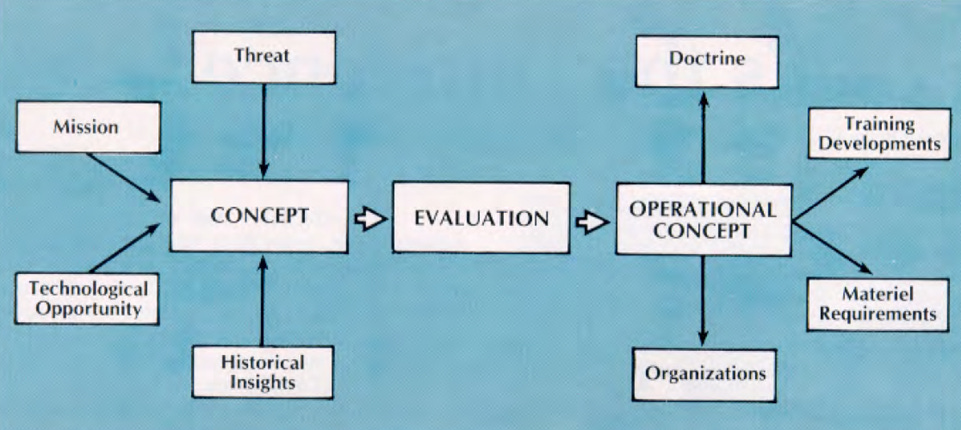
In this article, he uses the concept-to-doctrine process to show how the Army uses TOE and the Army authorization documents system (TAADS) to plan, program, and budget the force. Through these processes we get what we know as MTOEs.
At its core, the TOE is to standardize similar units and specify requirements. It is a blueprint that can be modified. The TAADS is used to bridge the gap between unit requirements and authorizations. As MAJ Zimmer highlights in the article, “the MTOE is the official authorization document by which TOE units requisition personnel and equipment. Without this approved general order document, no unit in the force can be activated or organized, and absolutely no personnel or equipment authorizations are in effect.” The TDA, on the other hand, is used when no particular TOE exists for a unit to perform a specific support mission.
Understanding your unit’s MTOE is critical to mission success. Thankfully, it is extremely easy to navigate and understand your unit’s organization by using the website FMSWeb. After a simple login with your CAC, you will be able to view not only your assigned unit’s organization but any unit in the Army. As a sustainer, this is perfect for us to understand the units we will be supporting. For those outside of the sustainment community, this is an excellent tool to understand the units you will be operating with. The more we understand the capabilities of the units to our left and right, the more lethal we will be on the battlefield. We cannot exist in a vacuum with tunnel vision and ignore the other units we are operating with.
This article is almost 38 years old, so of course doctrine has been updated since then. Thus, the current regulations that govern force development are Army Regulation 71-32, Force Development and Documentation Consolidated Polices, and Department of the Army Pamphlet 71-32, Force Development and Documentation Consolidated Procedures.
The Army Sustainment Professional Bulletin (ASPB) is the official professional journal for all things sustainment. We have been in operation since 1969 when we started as the Army Logistician and were retitled in 2009 to ASPB. Thus far, we have published 323 issues and are publishing fully digital, quarterly issues, which can be found here. Each quarterly issue is assigned a theme from the Sustainment Center of Excellence Board of Directors. While the Harding Project has increased our submission rate by 42%, we are always looking for new submissions. In addition to the journal, the Harding Fellow operates The LOGSTAT podcast to communicate directly with the professional sustainment community on topics that mean the most to them. They publish episodes every Thursday on Amazon Music, Apple Podcasts, Pandora, Spotify, and YouTube Music.
CPT Garett Pyle currently serves the first Harding Fellow for the Sustainment Center of Excellence at Ft. Lee, VA. As the Sustainment Harding Fellow, he is excited to work with anyone interested in contributing to the ASPB. You can find the submission instructions here.

As a lifelong student of military history (and a wargamer), I've come to the conclusion that nobody ever goes to war with their complete complement of manpower and equipment, not that it isn't accounted for. There always seems to be some people on leave of some kind or detached duty or en route to/from such situations. Equipment has gone astray or been damaged beyond use and the replacement isn't available or hasn't arrived. Vehicles of all kinds are in the motor pool awaiting parts or paper work, or there at another depot for the same situations, or they're en route to or from. Again, that doesn't mean there isn't paperwork accounting for everything!