

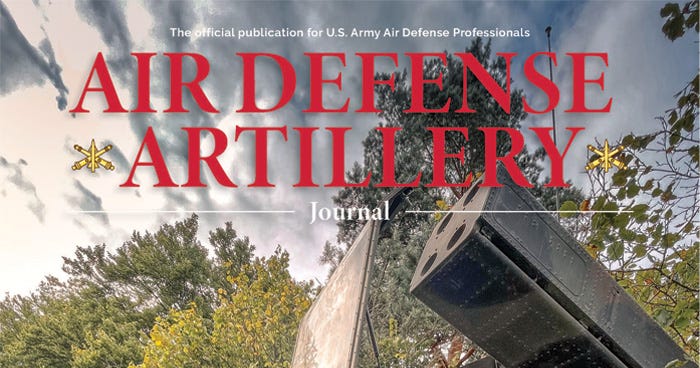
In 1976, COL Russell Parker and LTC Joseph House wrote an article for the Air Defense Magazine discussing the lack of sufficient air defense units for a ground war following the Korean and Vietnam wars. Because those wars were more comparable to counterinsurgency than large scale combat operations, the Army did not have a requirement for a large air defense force to be successful. Looking to the future, Parker and House did not believe the current force structure of the branch was sufficient for a near-peer war. They elaborate on the statistics of WWII that the majority of enemy aircraft kills were from the “curtain of lead” provided by anti-aircraft artillery (AAA) guns. These guns were so effective that they acted as major deterrents to Axis aircraft, preventing them from flying at lower altitudes. They draw comparisons to other nations’ air defense capabilities like USSR and Egypt as an example of just how lacking our defense are.
“Egypt alone has more SAMs along the Suez Canal than we possess in our total inventory”
The authors then provide a proposed unit organization that can bring the branch to the point it needs to be to be prepared for the next major conflict. They suggest the creation of Division Combat Air Defense (DIVCAD) or Corps Combat Air Defense Brigades (CAD). These units would give a mixture of shortrange air defense, surface-to-air missiles (SAMs), improved automatic weapons, and stingers to be at the disposal of the Division or Corps.

Figure 1. Proposed DIVCAD Structure

Figure 2. Proposed CAD Structure
The Cyclic Nature of Army Priorities
One of the most interesting parts about reading this article from 1976, 50 years later, is that it highlights that the Army appears to work in cycles. Modern day ADA is going through nearly the same process as Parker and House were describing back in 1976. In the early 2000s, air defense had Divisional Air Defense (DivAD) in nearly every major division in the Army. But with the Global War on Terror, the focus shifted from defending maneuver forces from air-breathing threats (helicopters, fighter jets, etc.) to defending strategic assets from ballistic missiles. With this change in focus, DivAD battalions slowly went away to make room for more Patriot Battalions to protect the growing list of strategic assets in the Middle East. Fast-forward to the 2026, the priority has switched from counterinsurgency to preparation for large scale combat operations against near-peer adversaries (Russia, China, Iran) which has highlighted a deficiency in air defense for the maneuver force. In order to combat this deficiency, the branch is standing up DivAD once again and developed the SGT Stout to provide needed coverage within the division.
Mix Simplicity with Complexity
With the growing technology in the world: artificial intelligence, electronic warfare, hypersonic cruise missiles, drones, etc.; the initial thought from a defense perspective is to “chase” advancement with more complexity. The emerging technologies for defense are constantly seeking to be “smarter” and more advanced. In some ways, this advancement is needed for the threats we see today like hypersonic cruise missiles and multi-release sub munitions that we must compete with in an “arms race”. This arms race is leaving behind some useful weapon systems that are not seen as advanced enough to keep up with the modern battlefield. Specifically, the AAA gun, a simplistic yet effective measure against low and slow flying threats like helicopters and small UAS. The writers of the original article acknowledged the technological growth in the 70s meant the requirement for SAM systems to compete with some of the threats, but they also acknowledged the effectiveness of the old AAA gun system (specifically the Vulcan).
“The MIGs and the SAMs get most of the publicity and glamour, but guns get most of the kills”
With their acknowledgment that both systems are crucial to defense, they suggested mixed capabilities units to provide a new “curtain of lead” capable of defeating the wide variety of threats. As today’s DIVAD battalions are being fielded with the SGT Stout, they aren’t mixed capability units. And with new increments of the SGT Stout, like directed energy, the complexity of the equipment continues to grow. Much like Parker and House suggested, DIVAD should consider a mix of the various increments of the SGT Stout to account for various threats.
The Importance of the Past
There are many lessons that can be learned from the past. There are rarely “new” problems in the Army, rather problems that are repeated from the past with slight changes. This article illustrates the Army’s priorities being cyclical between “COIN” to “LSCO” which changes the needs of the branch. ADA has transitioned from maneuver focused to point defense a couple of times in its history, so policy makers do not need to completely re-invent the wheel when it comes to determining what growth looks like and how to do it.
Here’s the full article, in its archived glory (Air Defense Magazine, April–June 1976, pp. 29–33):

CPT Peter Neil II is the Air Defense Artillery Harding Fellow. He works for the ADA Commandant’s Office, FCOE, Fort Sill, Oklahoma. He holds a Bachelor’s Degree in Mechanical Engineering from the Citadel: The Military College of South Carolina.

I remember my bemused response to the complete absence of any discussion of enemy aircraft or an enemy air threat during by training at Fort Knox in the summer and fall of 1972. Such confidence was remarkable.