

Here at Infantry, our professional bulletin is often confused with the Infantry Journal, a now-defunct periodical published by the then-United States Army Infantry Association from the early 1900s until the middle of the century. Few may know of our true lineage, which traces back to a different, distinct publication.
In 1921, still grappling with lessons from World War I as it continued to settle into its new home at Camp Benning, Ga., the U.S. Army’s Infantry School launched a new educational initiative to continue forging a unified and professional corps of Infantry leaders. Simply known as the “Mailing List” after its method of distribution, the endeavor aimed to provide Infantry Soldiers around the Army with the latest in tactics, doctrine, and military thought from the Army’s premier infantry institution.
In its first edition, “Tactical Problems,” Maj. R. H. Kelley, an instructor in the school’s Department of Military Art, explained the reasoning for the inaugural installment. During the Great War, he explained, the Army had to rapidly produce Soldiers who were highly proficient with individual weapons like machine guns or grenades but often “failed to appreciate the part each weapon or organization played in the great Infantry team.”
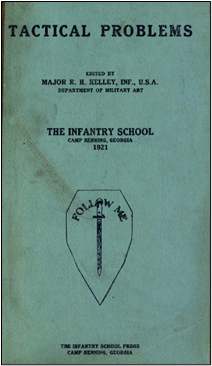
An emphasis on the study of tactics was seen as an essential remedy. “Infantry tactics employ certain basic principles designed to destroy the fighting strength of an enemy with the fewest casualties to the friendly forces…” Kelley stated. “The mission of an Infantry commander in action requires the highest degree of technical and tactical training, including a thorough appreciation of the powers, characteristics and limitations of all forces and weapons utilized.”
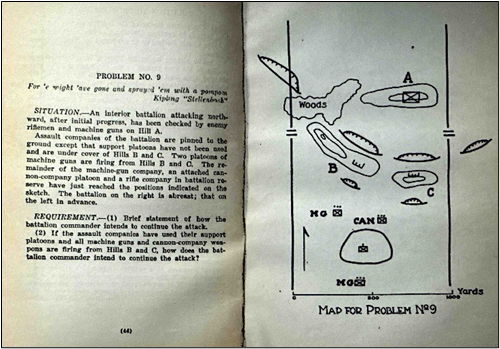
Based on instruction provided at the Infantry School, the 74-page pamphlet included 10 map problems or exercises – along with associated graphics, approved solutions and comments – for readers to explore. By distributing these materials, the school intended to extend its educational reach far beyond its classrooms in Georgia, ensuring that officers everywhere could build their professional training on a common and solid foundation while also fostering a unified understanding of the Infantry’s complex role on the battlefield.
Over the next few years, the school continued to regularly disseminate additional pamphlets consisting of these tactical problems along with lectures and other instructional material on topics ranging from assault and defense to the care of horses. While the intent was valid, the execution left subscribers wanting. In 1930, under then-Assistant Commandant Lt. Col. George C. Marshall, Maj. Edwin F. Harding (yes, as in the Harding Project) took on the task of revitalizing the publication. The foreword of the 1930-31 Mailing List succinctly notes, “The only reason for its existence is the dissemination of military instruction and the stimulation of thought on military subjects. If those who subscribe to it do not take the trouble to read it, it fails utterly in its sole purpose of being.”
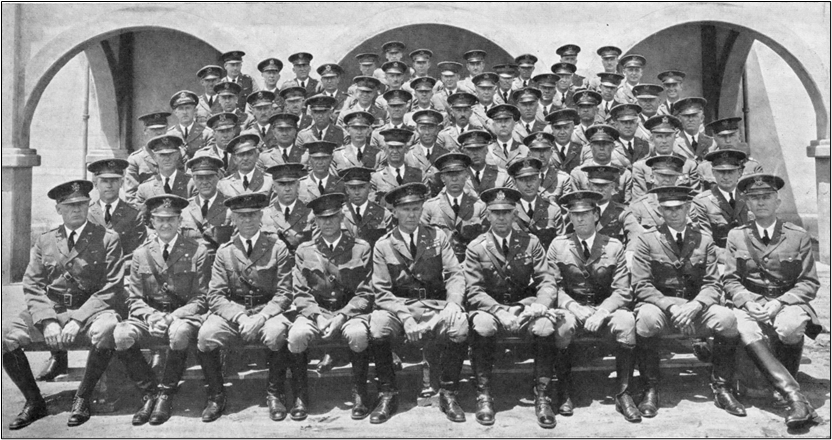
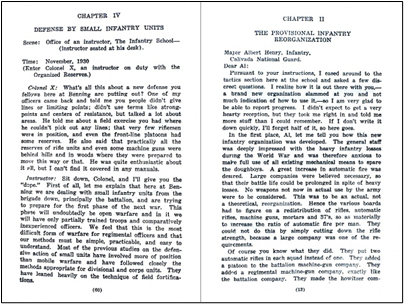
Beginning with that issue, Harding and his staff chose timely, relevant content in a variety of formats to break up the monotony and keep readers more engaged. For example, a discussion on infantry reorganization was framed as a personal letter between two officers, and an article on groundbreaking defensive tactics was presented as a candid dialogue between a skeptical visiting colonel and a knowledgeable school instructor. This shift in presentation made the material more digestible, transforming what would have been very dry content into memorable lessons.
That edition also included its first offerings based on firsthand accounts: “Experiences in the First Days of War,” a lecture delivered by a German Army captain to Infantry School students, and “The Operations of Company ‘K’, 38th Infantry, 3rd Division in the Second Phase of the Meuse-Argonne,” a monograph written by the company’s commander at the time, CPT Robert G. Moss, who received the first of his two Silver Stars for his actions on that patrol. CPT Moss closed his account with a list of lessons learned, which included practical tips like the value of carrying wire cutters to cut barbed wire to more abstract recommendations involving morale and the psychology of combat.
The publication continued to offer tactical decision exercises, complete with maps and solutions; however, the foreword to this section emphasized their purpose: “The problems are not intended to lay down rules; they are meant to stimulate thought.” This underscored a fundamental shift in philosophy at the time – teaching officers how to think versus what to think.
These changes marked a significant step in the publication’s evolution from a purely instructional tool to more of a forum for professional discourse. Over the years, as the Infantry School grew, so did its journal. In addition to adding more thought-provoking – even controversial – material, the publication changed formatting and names several times, morphing from the Mailing List into the Infantry School Quarterly in 1947 before finally settling as Infantry in 1957 – a legacy we proudly continue today.
Michelle Rowan currently serves as the civilian editor of Infantry, the professional bulletin of the U.S. Army’s Infantry Branch.

Thanks for writing this Michelle. Much of the back catalog of Mailing List and Infantry can be read here-
https://archive.org/details/pub_infantry