


This companion piece provides the ideas in brief and in practice for “Operation WARP Drive: Writing for the Army and Renewing the Profession: Closing the Consumer-to-Leader Innovation Gap” written by Major General John “Brad” Bowlin and Colonel Brian R. Hildebrand.1

Ideas in Brief
In 2025, The United States Army is in a unique position to leverage the last ten years of transformation to renew the profession and build on the momentum of innovation and ingenuity. The senior leaders’ call for submissions and appeal to aspiring writers has triggered a rise in production and output in professional journals. Many units have jumped on this bandwagon. In this vein, the 36 Infantry Division Commanding General, Major General John “Brad” Bowlin, launched Operation WARP Drive (OWD). OWD focuses on writing for the Army and renewal of the profession and provides opportunity, direction, and advice to aspiring writers in the 36ID.
Sharing experiences builds the professional discourse community of Army writers. The ideas in the full OWD article empower leaders to launch their own program for transforming in contact and professionalizing the force. OWD offers a way to tackle the consumer-to-leader innovation gap. Readers see in its application the core concepts of success and the blueprint for structure.
Success, they see, requires command emphasis and a multimodal approach flexible enough to adapt to the requirement-burdened operational environment of a COMPO II unit. The blueprint for structure offers a model from which they can cast their own mold. When readers analyze the parts of OWD and then synthesize their own versions, the implications are clear: a great launch ensures sufficient momentum for running a program. Running the program requires organizing content that appeals to the audience. And audience building entails cultivating a following of readers. You cannot make people participate—they must be motivated to do so on their own.
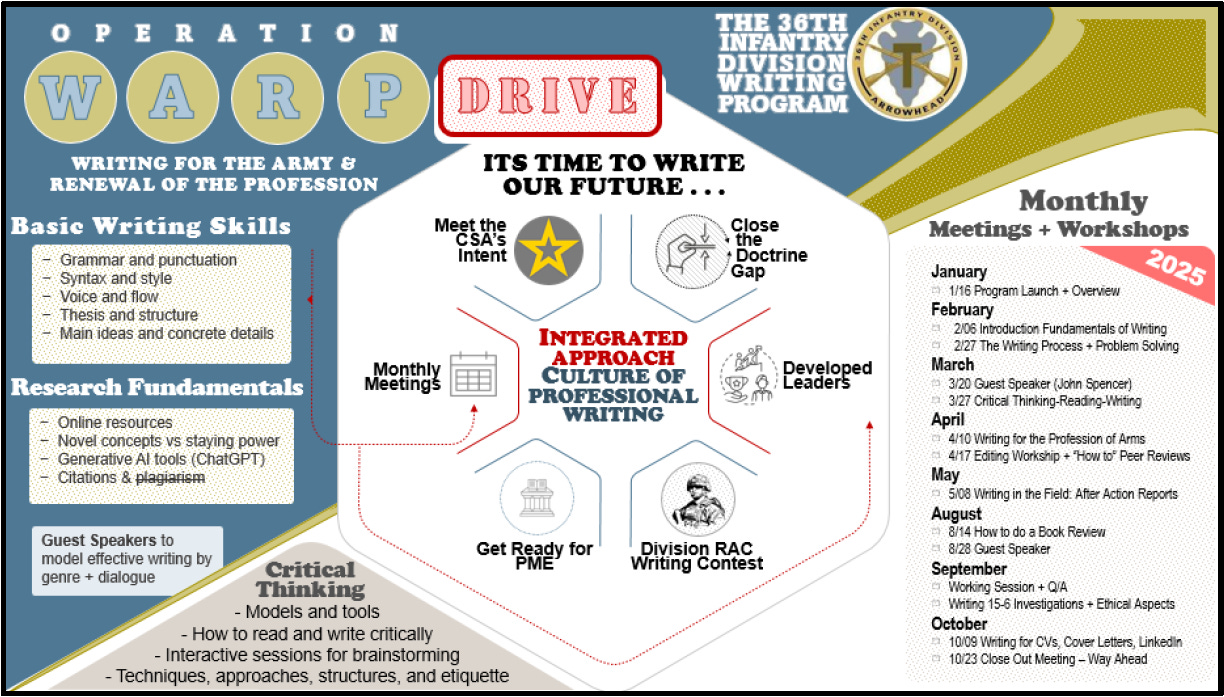
Photo courtesy of the authors.
Ideas in Practice
To build a unit writing program for a COMPO II unit, commanders must spend time and effort for its launch, management, and audience base. A commander’s journey begins with these questions:
How do I launch a writing program?
To effectively launch a writing program, commanders must achieve buy-in from senior leaders, charter the effort through key documents and an origin story, and create a corps of professionals dedicated to its birthing, survival, and eminence. OWD used infographics and command-endorsed memos to charter its effort and codify its origin story. It adopted the writing round table as its corps of professionals to not just launch the program, but to sustain it over the long term.
How do I run a writing program?
While running the program does require a dedicated corps of professionals, it also entails understanding the factors that affect timing, medium, and content. The tempo and time available within the unit’s operational schedule sets the basic rhythm of the program. Leaders must figure out the total number of touch points with the audience. Selecting the medium also challenges the commanders. How many meetings should be face-to-face? Is that even an option? OWD realized early on that face-to-face meetings require significant resources simply not available to COMPO II units. Figuring out the content and tone requires understanding the audience. What will appeal most to officers versus enlisted? Can you have something that does both? OWD achieved a sweet spot in content by magnifying the voices of its diverse audience members. Through the diversity writing round table participants, OWD was able to target the different populations within the audience.
How do I build the audience for a writing program?
In many ways the audience for the writing program will be predestined. The members of the unit are the writing program constituents. Building audience then is more than just outreach: it’s targeting, branding, and connecting an audience. Audience building engenders aspiring writers with know-how and confidence to tackle writing for a professional journal. As these aspiring writers grow in writing capacity and capability, they help to brand the program. Word of mouth success stories increase participation and grow the discourse community. The writing program also connects participants within the discourse community who, by their very inclusion, share similar goals and aspirations.
Final Thoughts
The 36 ID Commanding General used OWD to tackle a very tough problem—how do we transform our soldiers from consumers of innovation into leaders of innovation? Solving the problem in this way enabled the Commanding General to not only renew the Army profession within the division’s ranks, but also to inspire would-be-none writers to put something down on paper—even if it was just to nominate a lesson learned through the Center for Army Lessons Learned Quickfire Net. And, he connected aspiring writers with the professionals whose shared successes motivate us all to contribute to the Army’s professional writing forum.
1. I borrowed the format of Ideas in Brief, Ideas in Practice, and Final Thoughts from HBR’s 10 Must Reads: On Managing Yourself, Boston, Massachusetts: Harvard Business Review Press, 2010
