

“LESS IS MORE: Communications, Mission Command, and Survivability in the Future Operating Environment,” examines the escalating challenge electronic warfare (EW) poses to potential US military operations, particularly in the context of large-scale combat operations (LSCO) against a peer adversary such as the People’s Liberation Army of China (PLA). The full article (PDF below) critiques current US doctrine, training, and technological modernization efforts, arguing that an overreliance on electromagnetic (EM)-based technologies, especially communications, not only exposes US forces to serious vulnerabilities but also undermines mission command and overall survivability at the tactical level.

Technological Modernization and Its Limits
Services across the US military have embarked on broad modernization initiatives aimed at maintaining a technological edge over adversaries, with significant investment in advanced signals and communications capabilities. While these efforts are important, recent conflicts in Eastern Europe and the Middle East reveal the limitations and risks of such approaches. Specifically, adversaries’ growing EW capabilities have demonstrated how easily EM-dependent technologies can be compromised, resulting in operational paralysis, if not failure, and high casualties.
Lessons from Recent Conflict
This paper draws extensively from lessons learned in the Russia-Ukraine War to illustrate the dangers EW presents on the modern battlefield. Russian forces have effectively used EW to jam communications, geo-locate Ukrainian command posts, and even disrupt precision fires, making command and control (C2) and survivability major challenges for Ukrainian forces. The Ukrainian military’s high EM signature, largely due to its electronic communications, initially led to catastrophic losses. Adaptations, such as EM equipment stand-off from critical nodes, reduction in use of distinct military frequencies, and leveraging civilian infrastructure, such as cell phones and Starlink, have provided some mitigation, but these solutions remain vulnerable.
The recent civil war in Syria further highlights the risks of cyber-enabled EW. The proliferation of a seemingly legitimate mobile application among Syrian soldiers enabled the rebels to collect sensitive data and track force movements, demonstrating how human factors and everyday technology, like cell phones, can be exploited. Similarly, China’s “Salt Typhoon” cyber operation, which targeted global telecom providers, illustrates potential for adversaries to penetrate civilian and military communications infrastructure on a massive scale.
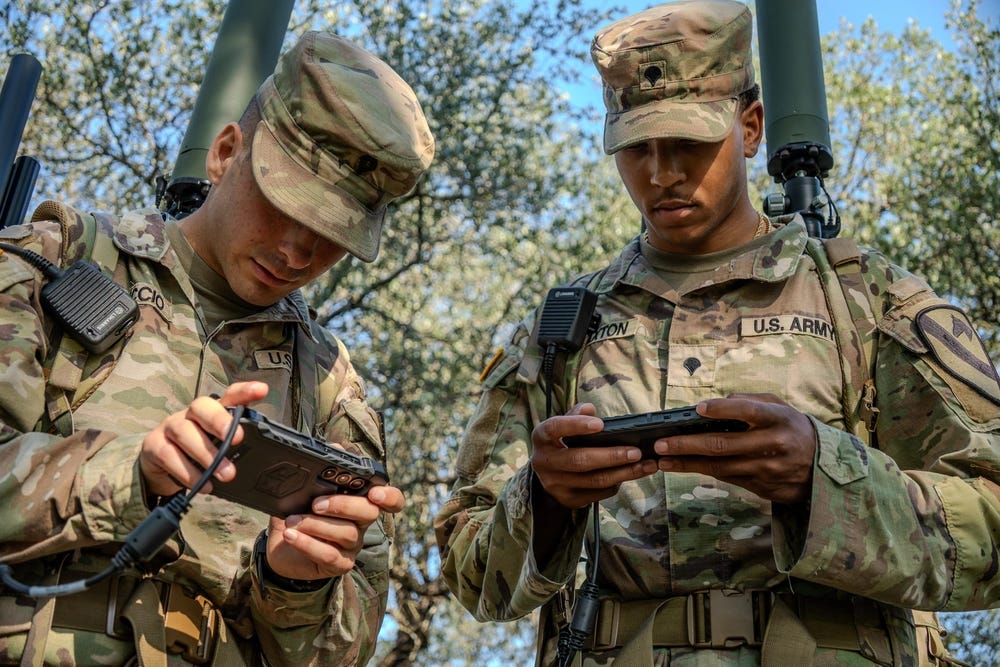
Photo courtesy of dvids.
PLA Doctrine and EW Threats
This section provides an overview of the PLA’s doctrine of system warfare, viewing its adversaries and their warfighting functions, as a network of interdependent systems to be isolated and exploited. The PLA seeks to isolate and exploit C2 and communications with the use of its tactical-level EW platforms in concert with fires and maneuver. The PLA’s operational sequencing integrates EW from the earliest phases – using electronic reconnaissance to locate US forces, then jamming and spoofing communications to induce isolation, confusion, and eventual collapse of US forces.
PLA tactics can also rapidly degrade US battalion-level operations, disrupt communications, and enable decisive maneuver and fires, resulting in the isolation and destruction of US small units. The scenario underscores how closely the PLA integrates EW with its other warfighting capabilities.
Current US Response and Shortcomings
The US Army’s response to the developing EW threat includes the development of the Terrestrial Layer System (TLS) Manpack, an all-in-one EW and signals intelligence tool for troops in Brigade Combat Teams. While promising, the TLS falls short in fielding timeline, usability, and practicality. Its complexity introduces training burdens and the potential for single points of failure, and its reliance on power, networks, and satellites further limit its practicality on the battlefield. In this scenario, there exists a fallacy of relying on a single technological solution, stressing the need for redundancy and contingency planning.
Even more broadly, current US doctrine and training do not adequately prepare units for the realities of EW in LSCO. Current field manuals, such as FM 3-12, offer only vague, reactive guidance (e.g., EMCON conditions that respond to enemy action rather than preempt it). Training scenarios at combat training centers rarely simulate the sum of adversarial EW capabilities and their effects, inhibiting a training unit’s understanding of how to effectively operate in a realistic contested environment, and further perpetuating a culture of overreliance on technology.
Recommendations: Embracing Less to Achieve More
There needs to be a paradigm shift – embracing “less is more” as a guiding principle. Some recommendations are as follows:
· Proactive Doctrine: Doctrine should assume EM denial or total compromise as the baseline in LSCO, with redefined EMCON Black as the starting point, only relaxing restrictions as the enemy EW threat changes as operations continue.
· Realistic Training: Units must train under conditions that reflect total EM denial or compromise from the smallest elements up through brigade level, developing and codifying new tactics, techniques, and procedures (TTPs) for communication, coordination, and control without electronic means.
· Redundant, Low-Tech Solutions: Signal plans should include visible and auditory signals, runners, wired field phones, and time-based triggers – reviving and adapting older methods to modern contexts.
· Mission Command by Intent: Leaders must return to the fundamentals of decentralized command, emphasizing commander’s intent, disciplined initiative, and trust in subordinates. The information-rich, real-time C2 environment of the Global War on Terror is no longer feasible in LSCO.
· Institutional Change: Military educational institutions, such as the Maneuver Captains Career Course, must integrate EW realities into curricula, exposing future leaders to the full spectrum of threats and empowering them to innovate solutions.
Conclusion
The evolving operational environment demands that US Forces explore an alternative route to the pursuit of ever more advanced EM technologies and cultivate resilience through doctrinal, training, and cultural adaptation. By accepting the likelihood of near total EM blackout conditions and rigorously preparing for it, military leaders can ensure that forces remain capable of fighting and winning under any circumstances. The path to better survivability and true operational advantage lies not in technological escalation alone, but in initiative, innovation, and a willingness to embrace “less” when the mission and the lives of service members are at stake.
Captain Nicholas Baker is an officer in the USMC. He is currently a student at Maneuver CCC at Fort Benning, GA.

Capt Baker - good article! I sent you an email in SEPCOR. For Harding Project teammates, here is an article from an Australian Army site from 2023 that I think you will find of interest:
https://groundedcuriosity.com/when-technology-fails/