

Before reading this post be sure to check out our article from 16 December below:
Why Are We Playing Checkers Instead of Chess?

The modern operational environment is characterized by increased complexity that requires agile and adaptive leaders. MCCC is the common core for all maneuver officers, select maneuver support officers, and international exchange officers. In preparation for company command and staff officer roles, the course provides a foundation in combined arms tacti…
Hello Fellow Hardos!
I found Brett Larkin’s 16 December 2025 post Why Are We Playing Checkers Instead Of Chess very interesting. This stirred a memory of doing similar low-cost/no-cost tactical table-top exercises when I was a company-grade officer, especially during Officer Professional Development (OPD) sessions at the Officers Club. One of the references we used was a document titled What Now, Lieutenant? that was put together in the 9th Infantry Division at Ft. Lewis during the division command tenures of GEN(ret) Richard E. Cavazos and LTG(ret) Howard F. Stone in the late 1970s.
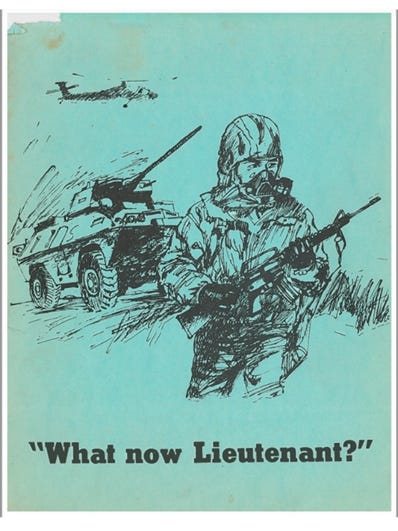
Photo courtesy of the author.
This document provided 22 different scenarios taken from historical, small unit actions to help prepare company-level leaders for future combat. As referenced, the 9th Infantry Division used a number of S.L.A. Marshall’s books, Rommel’s Infantry Attacks, and the US Army historical study on Small Unit Actions During the German Campaign in Russia (CMH Pub 104-22-1). The only resources required were either a sand table or a sketch map. Each scenario provided a re-written, current (at that time) situation with a fictional U.S. Army unit for the participants to consider and then discuss their decision(s). The scenario then concluded with not an “approved solution,” but the actual decision(s) made by the unit leader in the historical scenario.
Back in 2019, there was an excellent post at THE COMPANY LEADER website about using this document for unit-level tactical decision games that included a link to the PDF of the What Now, Lieutenant?
Another link to this document can be found at the Combat Studies Institute at the Army University Press.
I hope you take the time to read the hyperlinked file and perhaps find something that may be useful to you in your unit. Thank you!
Barrett F. Lowe
COL, USA (ret)

I think this is a great discussion! As a battalion and brigade commander I used the infantry and marine corps journals with staff duty officers. They would receive their topic the night prior and they would be allowed all night to come up with a recommended answer. Initially I kept it with the junior officer but expanded it to the junior NCO for teaming a solution. What I found reiterated the need for me to continue the mission. The officers had to brief a concise response and bring in the NCO added another level of complexity and response. Keep this going and well done Barrett Lowe! You are my hero!